

Quick Summary: World Cup Group Stage Scenarios Today
World Cup group stage scenarios are more important in 2026 because the tournament uses a 48-team format with 12 groups of four. Each team plays three group matches. The top two teams in every group qualify automatically, and the eight best third-place teams also advance to the Round of 32.
That means a team can still survive after finishing third, but the path is risky. Points, goal difference, goals scored, discipline, and results in other groups can all matter.
This page explains how qualification works, how to read group standings, what teams usually need on Matchday 3, and how best third-place teams are decided.
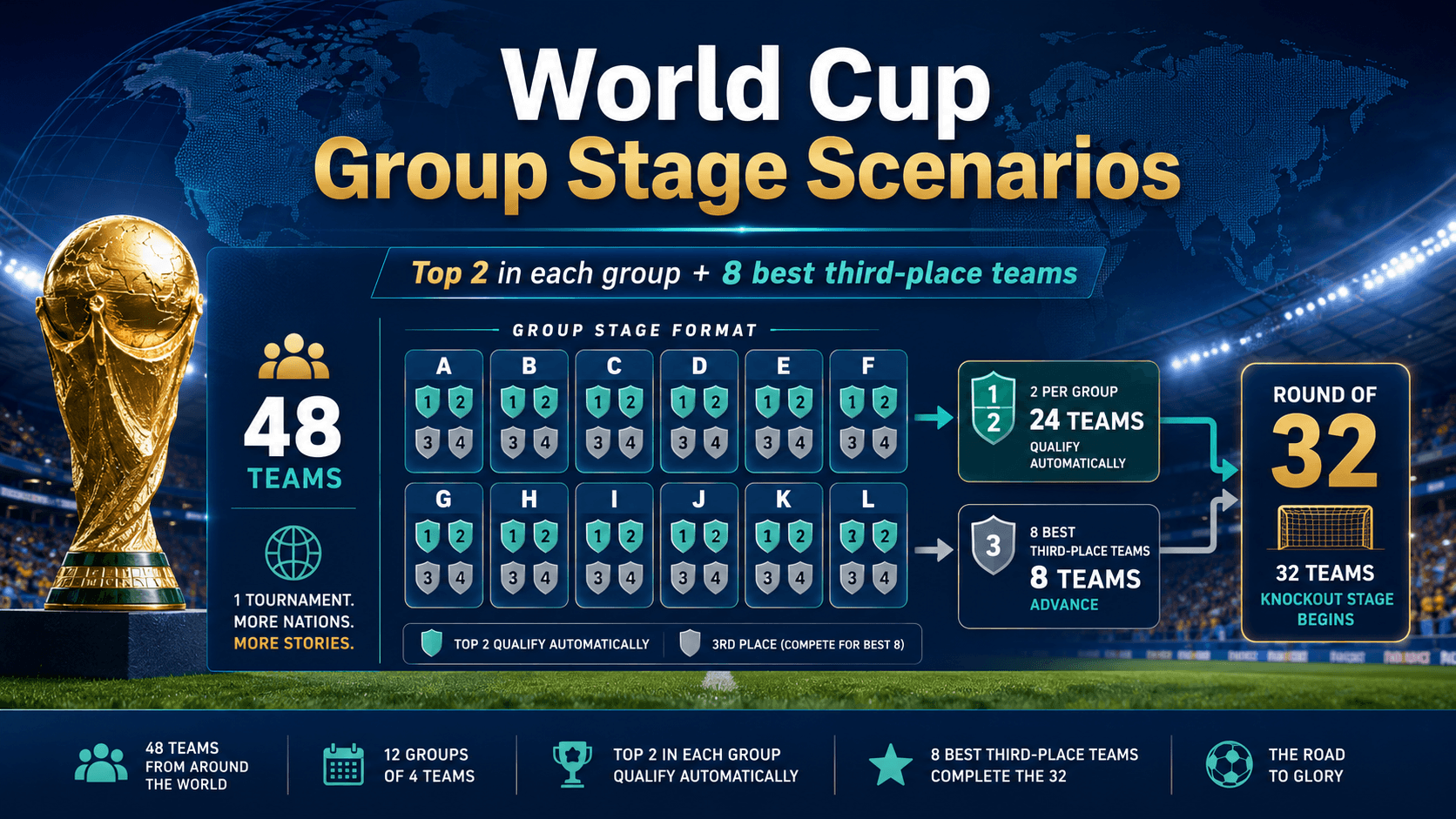
World Cup group stage scenarios showing qualification paths top two teams and best third-place teams
Qualification Route | How It Works |
Group winner | Advances to the Round of 32 |
Group runner-up | Advances to the Round of 32 |
Best third-place teams | 8 of 12 third-place teams advance |
Eliminated third-place teams | 4 of 12 third-place teams are eliminated |
Fourth-place teams | Eliminated |
Tie-breakers | Points, goal difference, goals scored, head-to-head and other FIFA criteria |
The simplest way to follow the group stage is to ask three questions: Is the team already qualified? Can it still finish in the top two? If not, can it survive through the best third-place table?
Latest World Cup Group Stage Scenarios Snapshot
The quickest way to understand World Cup group stage scenarios is through a live-style snapshot. Each group should be read by status: qualified, still alive, third-place watch, or eliminated.
This tracker format works throughout the group stage. It can be refreshed after each matchday as teams qualify, drop into third-place danger, or lose their route to the knockout round.
Group | Qualified | Still Alive | Eliminated | Key Scenario |
Group A | Team / TBD | Team / TBD | Team / TBD | Winner, runner-up or third-place race |
Group B | Team / TBD | Team / TBD | Team / TBD | Qualification depends on final matchday |
Group C | Team / TBD | Team / TBD | Team / TBD | Goal difference may decide |
Group D | Team / TBD | Team / TBD | Team / TBD | Third-place route in play |
Group E | Team / TBD | Team / TBD | Team / TBD | Two teams fighting for second |
Group F | Team / TBD | Team / TBD | Team / TBD | One team can qualify with draw |
Group G | Team / TBD | Team / TBD | Team / TBD | All four still alive |
Group H | Team / TBD | Team / TBD | Team / TBD | Best third-place pressure |
Group I | Team / TBD | Team / TBD | Team / TBD | Leader can secure top spot |
Group J | Team / TBD | Team / TBD | Team / TBD | Knockout path still open |
Group K | Team / TBD | Team / TBD | Team / TBD | Final matchday decisive |
Group L | Team / TBD | Team / TBD | Team / TBD | Goal difference likely important |
Status Labels Used in This Tracker
Label | Meaning |
Qualified | Already through to the Round of 32 |
Can qualify with win | Advances by winning next match |
Can qualify with draw | One point may be enough |
Needs help | Depends on another result |
Third-place watch | Could advance as one of the best third-place teams |
Eliminated | Cannot reach the knockout round |
This label system is useful because World Cup group stage scenarios can change quickly. A late goal in one match can affect not only one team’s group position, but also the best third-place table across the tournament.
How World Cup 2026 Knockout Qualification Works
The 2026 World Cup qualification format is different from the older 32-team version. Instead of eight groups and a Round of 16, the expanded tournament has 12 groups and a Round of 32.
That makes the group stage easier to enter but harder to read. More teams survive the first round, but the third-place comparison adds another layer.
2026 Format Rule | What It Means |
48 teams | Expanded tournament field |
12 groups | Groups A through L |
Four teams per group | Each team plays three group matches |
Top two advance | 24 automatic qualifiers |
Eight best third-place teams | 8 more teams enter Round of 32 |
Round of 32 | First knockout round |
Every team still plays three group matches. A win is worth three points, a draw is worth one, and a loss is worth zero.
The top two in each group qualify automatically. After that, the 12 third-place teams are compared, and eight of them also move into the knockout round.
Why the 2026 Format Changes the Scenario Math
In older World Cups, finishing third usually meant elimination. In 2026, third place can be enough. That makes group-stage decisions more complicated.
A team may not need to finish second to survive, but finishing third can still create a worse knockout path. A team in third place may also need to wait for results from other groups before knowing whether it has advanced.
Scenario Type | Why It Matters |
Top-two finish | Safest route into the Round of 32 |
Third-place finish | Possible route, but depends on other groups |
Goal difference race | Can decide cross-group ranking |
Late match timing | Later groups may know what result is needed |
Knockout bracket path | Finish position affects next opponent |
That is why World Cup group stage scenarios are not just about points. They are also about timing, tiebreakers, and bracket position.
Top Two in Each Group: What Teams Need
The safest route is simple: finish first or second in the group.
A team that wins its first two matches is usually in a very strong position. A team with four points after two matches often controls its own destiny. A team with three points may still be safe, but it usually needs a result in the final match.
Team Position Before Final Match | What Usually Helps |
1st place with 6 points | May already be qualified |
1st or 2nd with 4 points | Draw may be enough |
2nd with 3 points | Win likely secures a stronger position |
3rd with 3 points | Needs win or third-place route |
4th with 0–1 point | Usually needs win plus help |
These are general patterns, not guarantees. The exact scenario depends on points, goal difference, goals scored, and the other match in the group.
Why Winning the Group Still Matters
Because third-place teams can advance, some fans may think group position matters less. It still matters a lot.
Winning the group can produce a better knockout path, more confidence, and sometimes a more favorable Round of 32 opponent. Finishing second is still automatic qualification, but the route can become harder. Finishing third adds uncertainty and can leave the team waiting on other results.
Finish | Qualification Status | Practical Impact |
1st | Automatic | Usually strongest path |
2nd | Automatic | Safe, but path may be tougher |
3rd | Conditional | Must rank among best third-place teams |
4th | Eliminated | No knockout route |
For fans following World Cup group stage scenarios, the top-two race should always be read first. The third-place route is important, but it is a backup path, not the cleanest path.
Best Third-Place Teams Explained
The best third-place table is one of the most important new features of the 2026 World Cup format.
There are 12 groups, so there are 12 third-place teams. Eight advance to the Round of 32. Four are eliminated.
That means third-place teams are compared across different groups, not only inside their own group.
Third-Place Ranking Factor | Why It Matters |
Points | Main comparison across third-place teams |
Goal difference | Separates teams level on points |
Goals scored | Rewards attacking output |
Discipline / fair play | Can matter in deeper tie-breakers |
Other group results | A team’s fate can depend on matches elsewhere |
What Is Usually Enough for Third Place?
Before all groups finish, no third-place total is automatically safe unless the math confirms it. Still, some patterns are useful.
Third-Place Record | Likely Scenario |
4 points | Often a strong position |
3 points with positive goal difference | Good chance, but not safe |
3 points with negative goal difference | Riskier |
2 points | Needs several favorable results |
1 point | Usually in serious danger |
A team with four points and a positive goal difference may feel comfortable, but it still depends on the full tournament table. A team with three points may need goals scored or fair-play criteria to matter.
Why Goal Difference Becomes So Important
A third-place team can finish with the same points as several other third-place teams. When that happens, goal difference can become decisive.
Example Third-Place Team | Points | Goal Difference | Scenario |
Team A | 4 | 1 | Strong third-place position |
Team B | 4 | -1 | Still alive, but less secure |
Team C | 3 | 2 | Competitive |
Team D | 3 | -3 | High risk |
This is why late goals matter. A team losing 2-0 instead of 1-0 can damage its cross-group ranking. A team scoring a late consolation goal can improve its chances in the best third-place table.
Current Group Scenarios: Groups A–L
This section is designed to work as the main update area during the tournament. Each group can be refreshed after matchdays with points, goal difference, and qualification labels.
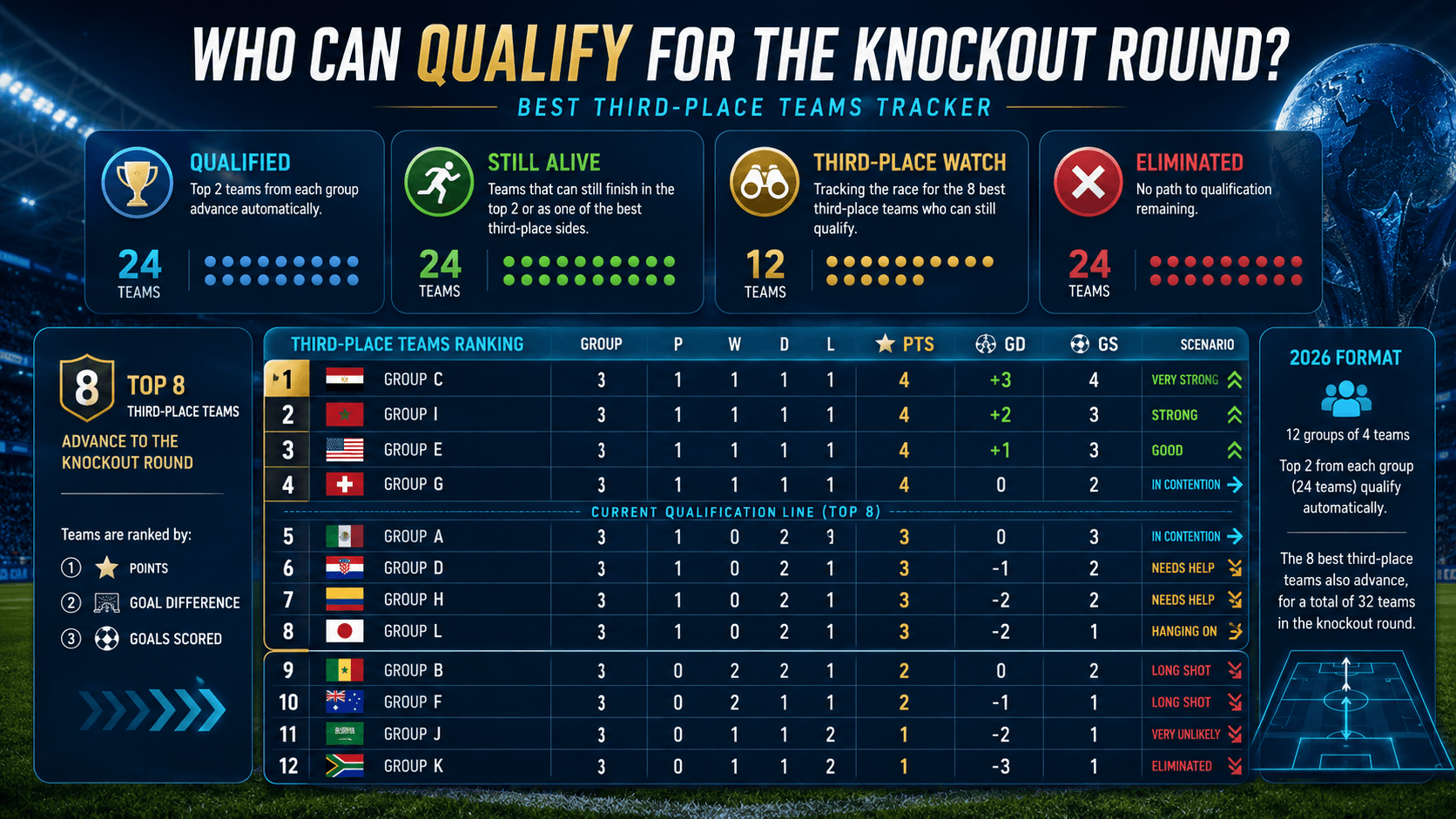
World Cup group stage scenarios explained with best third-place teams and knockout qualification tracker
Group A Scenarios
Team | Points | Goal Difference | Scenario |
Team 1 | TBD | TBD | Can qualify / already qualified |
Team 2 | TBD | TBD | Top-two race |
Team 3 | TBD | TBD | Third-place route possible |
Team 4 | TBD | TBD | Needs result and help |
Group A scenarios should focus on whether the leader has secured qualification, whether second place is open, and whether the third-place team has a realistic cross-group route.
Group B Scenarios
Team | Points | Goal Difference | Scenario |
Team 1 | TBD | TBD | Can secure top spot |
Team 2 | TBD | TBD | Needs draw or win |
Team 3 | TBD | TBD | Must improve goal difference |
Team 4 | TBD | TBD | Elimination risk |
Group B should be tracked by final-match pressure. If two teams are level on points, tie-breakers can become central.
Group C Scenarios
Team | Points | Goal Difference | Scenario |
Team 1 | TBD | TBD | Controls qualification |
Team 2 | TBD | TBD | Top-two path open |
Team 3 | TBD | TBD | Third-place watch |
Team 4 | TBD | TBD | Must win |
Group C may be especially important if one favorite drops points early. A draw-heavy group can make third-place comparison more likely.
Group D Scenarios
Team | Points | Goal Difference | Scenario |
Team 1 | TBD | TBD | Strong qualification position |
Team 2 | TBD | TBD | Needs result |
Team 3 | TBD | TBD | Can qualify with help |
Team 4 | TBD | TBD | Goal difference pressure |
In Group D, watch whether the final matchday creates a situation where a draw suits one team but not the other.
Group E Scenarios
Team | Points | Goal Difference | Scenario |
Team 1 | TBD | TBD | Can finish first |
Team 2 | TBD | TBD | Competing for second |
Team 3 | TBD | TBD | Third-place route possible |
Team 4 | TBD | TBD | Needs win and help |
Group E can become complicated if three teams remain alive entering Matchday 3.
Group F Scenarios
Team | Points | Goal Difference | Scenario |
Team 1 | TBD | TBD | Qualification close |
Team 2 | TBD | TBD | Draw may be enough |
Team 3 | TBD | TBD | Needs win |
Team 4 | TBD | TBD | Elimination risk |
Group F scenarios should highlight whether goal difference or head-to-head criteria can separate tied teams.
Group G Scenarios
Team | Points | Goal Difference | Scenario |
Team 1 | TBD | TBD | Leader |
Team 2 | TBD | TBD | Still alive |
Team 3 | TBD | TBD | Still alive |
Team 4 | TBD | TBD | Still alive / at risk |
If all four teams remain alive, Group G becomes one of the most volatile sections of the tournament.
Group H Scenarios
Team | Points | Goal Difference | Scenario |
Team 1 | TBD | TBD | Can qualify |
Team 2 | TBD | TBD | Needs result |
Team 3 | TBD | TBD | Best third-place watch |
Team 4 | TBD | TBD | Must win |
Group H should focus on whether a third-place team can build enough points and goal difference to survive across groups.
Group I Scenarios
Team | Points | Goal Difference | Scenario |
Team 1 | TBD | TBD | Can win group |
Team 2 | TBD | TBD | Top-two race |
Team 3 | TBD | TBD | Needs help |
Team 4 | TBD | TBD | Elimination pressure |
Group I scenarios often become clearer if the leader has already beaten a direct rival.
Group J Scenarios
Team | Points | Goal Difference | Scenario |
Team 1 | TBD | TBD | Qualification path strong |
Team 2 | TBD | TBD | Can secure second |
Team 3 | TBD | TBD | Third-place route possible |
Team 4 | TBD | TBD | Must chase goals |
Group J may be a goal-difference group if teams are close on points.
Group K Scenarios
Team | Points | Goal Difference | Scenario |
Team 1 | TBD | TBD | Strong position |
Team 2 | TBD | TBD | Needs result |
Team 3 | TBD | TBD | Third-place comparison |
Team 4 | TBD | TBD | Needs win |
Group K should be updated closely if Matchday 3 includes a direct qualification battle.
Group L Scenarios
Team | Points | Goal Difference | Scenario |
Team 1 | TBD | TBD | Can finish first |
Team 2 | TBD | TBD | Top-two race |
Team 3 | TBD | TBD | Third-place watch |
Team 4 | TBD | TBD | Elimination risk |
Group L can affect the final best third-place table because later groups may know exactly what points or goal difference target is needed.
For more on how a difficult draw changes qualification pressure, read Freebetspin’s World Cup group of death explained guide.
World Cup Group Standings Tracker Template
A group standings tracker should show the basic ranking first, then add scenario labels. This lets fans quickly understand what each team needs.
Group | 1st | 2nd | 3rd | 4th | Current Status |
A | TBD | TBD | TBD | TBD | Group open |
B | TBD | TBD | TBD | TBD | Group open |
C | TBD | TBD | TBD | TBD | Group open |
D | TBD | TBD | TBD | TBD | Group open |
E | TBD | TBD | TBD | TBD | Group open |
F | TBD | TBD | TBD | TBD | Group open |
G | TBD | TBD | TBD | TBD | Group open |
H | TBD | TBD | TBD | TBD | Group open |
I | TBD | TBD | TBD | TBD | Group open |
J | TBD | TBD | TBD | TBD | Group open |
K | TBD | TBD | TBD | TBD | Group open |
L | TBD | TBD | TBD | TBD | Group open |
Useful Status Terms
Status | Meaning |
Group open | No final position secured |
Leader qualified | First-place team is through |
Top-two race | Two or more teams fighting for automatic spots |
Third-place watch | Third-place ranking matters |
Group settled | Final positions decided |
Elimination battle | At least one team must win to survive |
This structure helps avoid confusion. Instead of only showing a table, the page explains what the table means.
Tie-Breakers Explained in Plain English
Tie-breakers decide World Cup group stage scenarios when teams finish level on points.
The first thing fans should check is points. After that, FIFA’s published competition rules and group qualification guides explain the order of tie-breakers used to rank teams.
A simplified version looks like this:
Tie-Breaker | Plain-English Meaning |
Points | Total points from three group matches |
Goal difference | Goals scored minus goals conceded |
Goals scored | Total goals scored in group matches |
Head-to-head criteria | Results between tied teams |
Fair play / team conduct | Yellow and red card discipline |
Drawing of lots / ranking fallback | Final fallback if teams remain tied |
Simple Tie-Breaker Example
Team | Points | Goals For | Goals Against | Goal Difference |
Team A | 4 | 4 | 3 | 1 |
Team B | 4 | 3 | 3 | 0 |
Team A ranks above Team B because goal difference is better.
If goal difference is also tied, goals scored or head-to-head criteria can become important. That is why every goal can matter, even when a team is already winning or losing.
Why Discipline Can Matter
Fair play points can be used deeper in the tie-breaker process. That means cards can matter if teams are extremely close.
Card Situation | Why It Can Matter |
Fewer yellow cards | Better fair-play record |
Red card | Can hurt discipline score |
Late unnecessary cards | Can become costly in rare scenarios |
Tactical fouls | May affect deeper tie-breakers |
Discipline usually does not decide most groups, but it can become relevant when teams are tied across several major categories.
How Matchday 3 Changes Qualification Scenarios
Matchday 3 is where World Cup group stage scenarios become most intense. Teams no longer play only for a result; they play for a specific table outcome.
Some teams need a win. Some need a draw. Some need goal difference. Some need help from the other match. Others may already be qualified and choose to rotate players.
Matchday 3 Situation | What It Usually Means |
Team on 6 points | May rotate if already qualified |
Team on 4 points | Draw often enough, win secures better path |
Team on 3 points | Win is usually important |
Team on 2 points | Needs win and third-place help |
Team on 1 point | Needs win and other results |
Team on 0 points | Usually close to elimination |
Why Motivation Changes Match Style
A team needing a win may attack more. A team needing only a draw may become cautious. A team chasing goal difference may keep pushing even while leading.
Scenario | Possible Match Style |
Must win | More attacking risk |
Draw enough | More conservative shape |
Need goal difference | Late attacking pressure |
Already qualified | Possible rotation |
Rival result matters | Live tactical changes |
This is also why live group-stage updates can become volatile. A goal in another match can change what a team needs in real time.
Knockout Round Paths: Why Finishing Position Matters
Qualifying is only the first step. Finishing position matters because it affects the Round of 32 path.
A group winner may receive a more favorable bracket route than a runner-up or third-place team. A third-place qualifier may advance, but the next matchup can be harder.
Finish | Why It Matters |
1st place | Usually strongest bracket position |
2nd place | Automatic, but path may be harder |
3rd place | Can advance, but opponent path may be less favorable |
4th place | Eliminated |
This is why teams do not always settle for a safe third-place route. Winning the group can matter for rest, confidence, travel, and opponent quality.
For a fuller explanation of how the draw, pots and group structure work, read Freebetspin’s World Cup draw guide.
World Cup Group Stage Scenarios for Bettors and Fans
World Cup group stage scenarios matter for fans, but they also affect betting markets. A team’s motivation can change its lineup, risk level and match style.
A team that must win may attack more aggressively. A team that has already qualified may rest starters. A team that needs goal difference may keep pushing late.
Scenario | Market Impact |
Team must win | More attacking intent, but more risk |
Team needs draw | Can become cautious |
Already qualified team | Rotation risk |
Goal difference needed | Late attacking pressure |
Third-place route possible | Incentives may shift |
Rival result matters | Live market volatility |
This does not create guaranteed betting angles. It simply means context matters.
A team’s quality is only one part of the picture. Points, schedule, rotation, cards, injuries and motivation can all affect how a match plays.
For a broader tournament betting overview, see Freebetspin’s World Cup betting guide, which explains odds, markets, legal access, futures, group-stage decisions and responsible betting reminders.
How to Read This Page During Live Updates
World Cup group stage scenarios are easiest to follow if you read the page in order.
First, check whether any team has already qualified. Then look at who can still finish top two. After that, check the best third-place situation.
Step | What to Check |
1 | Current group table |
2 | Points and goal difference |
3 | Scenario label |
4 | Top-two route |
5 | Third-place route |
6 | Tie-breaker risk |
7 | Knockout path |
Scenario Label Guide
Label | How to Read It |
Qualified | Team is already through |
Can qualify with win | Next match win secures place |
Can qualify with draw | One point may be enough |
Needs help | Other result matters |
Third-place watch | Best third-place table matters |
Eliminated | No knockout route remains |
The best way to use this tracker is to read the table first, then the scenario note. The table gives the standings. The scenario note explains what the standings mean.
Update Log
Date | Update |
26 June 2026 | Published base 2026 group-stage scenarios framework |
23 June 2026 | Added top-two qualification and third-place route explainer |
18 June 2026 | Added tie-breaker guide and Matchday 3 scenario framework |
14 June 2026 | Added group-by-group tracker template for Groups A–L |