

Quick Summary: Overround Betting
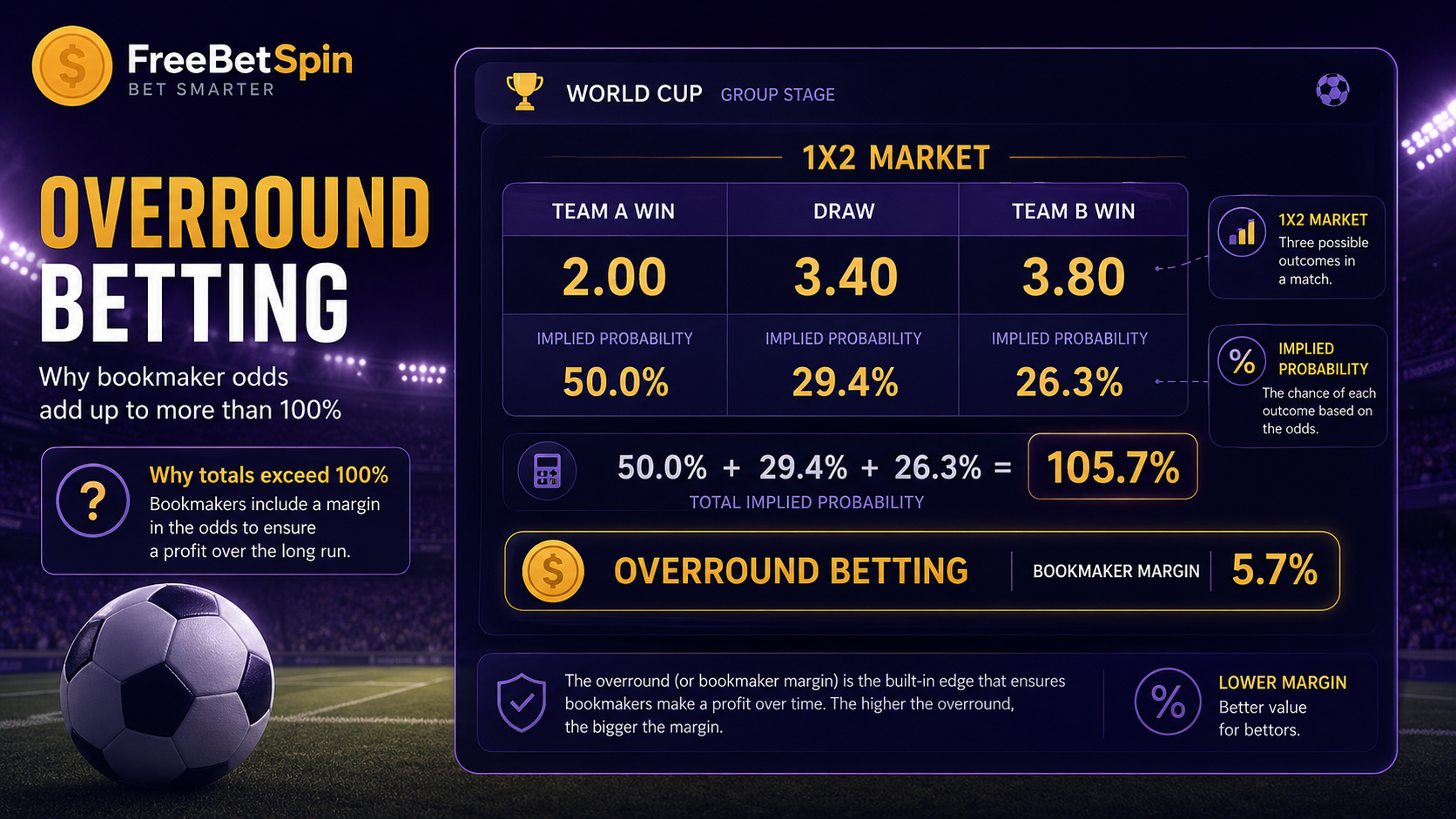
Overround betting explains why the implied probabilities in a betting market often add up to more than 100%. In a fair no-margin market, all possible outcomes would total exactly 100%. In a sportsbook market, the total is usually higher because the bookmaker builds margin into the odds.
Here is the simple idea. A soccer match has three possible 1X2 outcomes: Team A wins, the match is a draw, or Team B wins. When you convert all three odds into implied probabilities, the total may come out to 105% or 106%, not 100%. The extra percentage above 100% is the overround.
That does not mean the sportsbook is “cheating.” It also does not mean every bettor automatically loses that exact percentage on every bet. Overround is part of how sportsbook pricing works.
overround betting explained with bookmaker margin and implied probability in soccer odds
Concept | Simple Meaning |
Implied probability | Betting odds converted into a percentage chance. |
Fair market | All possible outcomes add up to 100%. |
Overround | The total implied probability above 100%. |
Bookmaker margin | The sportsbook’s built-in pricing edge. |
Lower margin | Often more competitive pricing for bettors. |
Higher margin | Odds may be less favorable overall. |
What Does Overround Betting Mean?
Overround betting refers to the total implied probability of all outcomes in a betting market. If that total is above 100%, the extra amount is the overround.
In soccer, the easiest example is a 1X2 match market. There are three possible outcomes: the listed home team wins, the match ends in a draw, or the listed away team wins. One of those outcomes must happen after the settlement period, usually 90 minutes plus stoppage time for standard 1X2 markets.
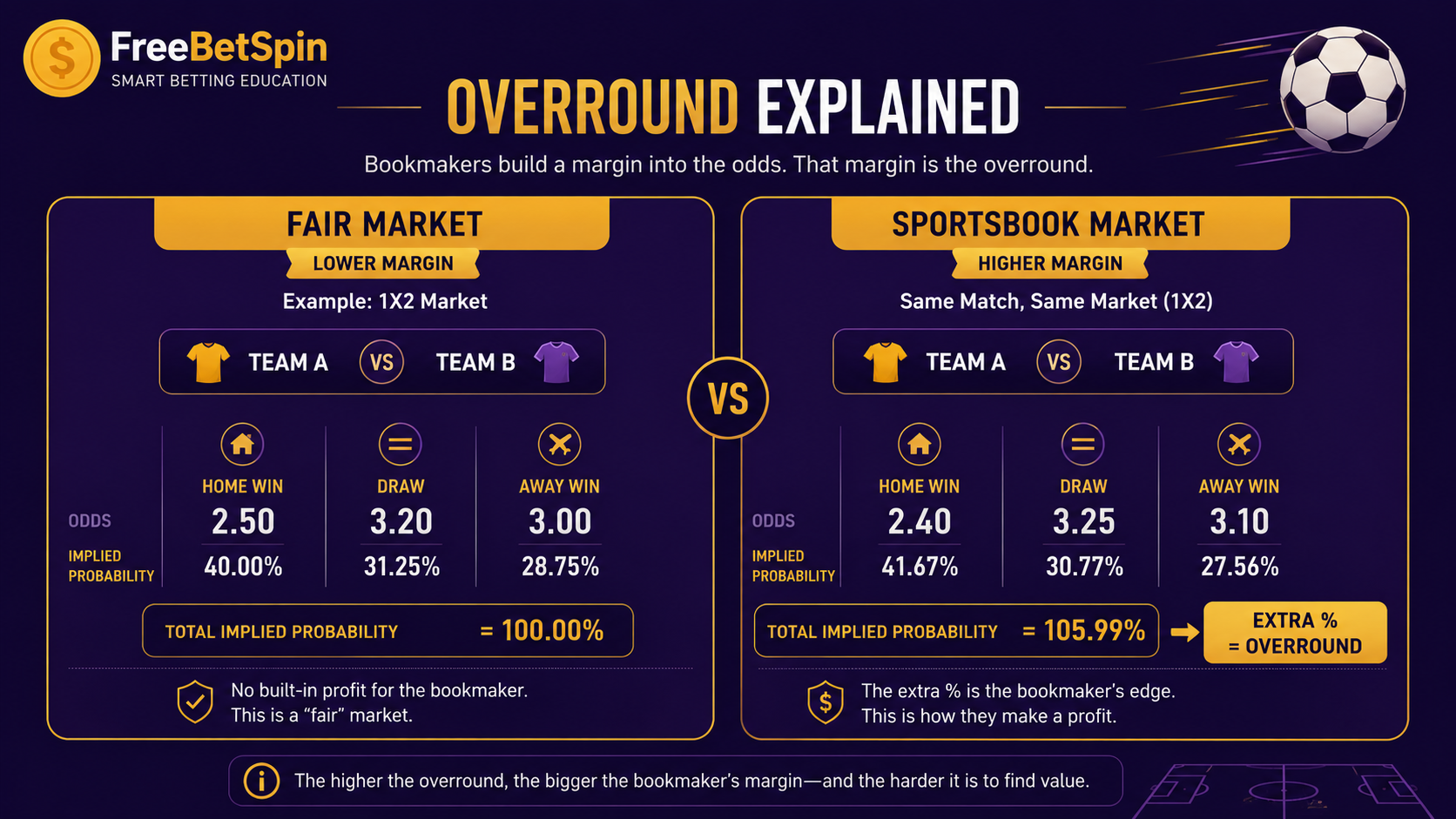
If the sportsbook priced the market with no margin, the implied probabilities would add up to 100%. In real betting markets, the total is often above 100% because the odds include bookmaker margin.
Market Type | Outcomes Included in the Overround |
1X2 soccer betting | Home win, draw, away win |
Over/Under goals | Over, under |
Both teams to score | Yes, no |
Asian Handicap | Each side of the handicap line |
Futures market | Every listed team or possible winner |
The key point is that overround is calculated within one market. You should not mix unrelated bets. For example, do not combine a match winner market, a player prop, and a futures price and treat them as one overround calculation.
Why Betting Probabilities Add Up to More Than 100%
In real-world probability, all possible outcomes should total 100%. A soccer match cannot finish as both a Team A win and a Team B win. If all outcomes are included, the total should equal one complete event.
Sportsbook odds are different because they are not pure probability. They are prices. Those prices include the bookmaker’s margin.
That is why overround betting can surprise beginners. You may convert Team A, draw, and Team B into implied probability and see a total like 105.7%. At first, that feels strange. But it simply means the market has a 5.7% margin built into the odds.
Market Type | Fair Probability Total | Common Sportsbook Total |
No-margin market | 100% | Rare in normal sportsbook betting |
Low-margin market | 100% | Around 101%–104% |
Standard sportsbook market | 100% | Around 104%–108% |
Higher-margin market | 100% | Often 108%+ |
A higher overround does not tell you which team will win. It tells you the market is priced with more margin. A lower overround does not guarantee profit, but it can mean the overall prices are more competitive.
Overround Betting vs Bookmaker Margin
Overround betting and bookmaker margin are closely related, and many bettors use the terms in similar ways. The difference is mostly about how the idea is described.
Overround usually refers to the full implied probability total above 100%. Bookmaker margin refers to the sportsbook’s built-in edge inside the odds.
If a soccer 1X2 market adds up to 106%, the overround is 106%, and the margin above the fair 100% baseline is 6%.
Term | Simple Meaning | How You Might See It |
Overround | Total implied probability in the market | 106% total book |
Bookmaker margin | The amount above 100% | 6% margin |
Vig / Juice | Cost included in betting prices | Common U.S. betting term |
Hold | Operator-level retained revenue over time | More useful for business analysis |
For beginners, the most useful wording is this: overround betting shows how much extra probability is built into a market compared with a clean 100% probability total.
Example: A World Cup 1X2 Match Market
Let’s use a simple World Cup match example. Imagine Team A is favored, Team B is the underdog, and the draw is also available.
Outcome | Decimal Odds | Implied Probability |
Team A Win | 2 | 50.00% |
Draw | 3.4 | 29.40% |
Team B Win | 3.8 | 26.30% |
Total | — | 105.70% |
In normal probability terms, Team A win, draw, and Team B win should add up to 100%. In this example, they add up to 105.7%.
That extra 5.7% is the overround. It represents the bookmaker margin built into the 1X2 market.
Here is the same idea using American-style odds:
Outcome | American Odds | Approx. Implied Probability |
Favorite | -120 | 54.50% |
Draw | 260 | 27.80% |
Underdog | 360 | 21.70% |
Total | — | 104.00% |
This does not mean the favorite has a guaranteed 54.5% chance to win. It means the odds price converts to that approximate implied probability before adjusting for margin.
For a deeper beginner-friendly explanation of odds and implied probability, read Freebetspin’s guide to soccer betting odds explained.
overround betting example using World Cup 1X2 soccer odds and implied probability
How to Calculate Overround in Soccer Betting
You do not need advanced math to understand overround betting. The process is simple once you know implied probability.
First, convert each outcome’s odds into implied probability. Then add the percentages together. Finally, subtract 100%. The result is the margin above a fair 100% market.
Simple formula:
Overround Margin = Total Implied Probability − 100%
Step | What You Do |
1 | Convert each outcome into implied probability. |
2 | Add all implied probabilities together. |
3 | Compare the total with 100%. |
4 | Anything above 100% is the overround margin. |
Quick Example
If a market adds up to 106%, the margin above 100% is 6%.
If another market adds up to 103%, the margin above 100% is 3%.
The second market has a lower overround, which may indicate more competitive pricing. That does not mean the bet is automatically good, but it does mean less margin is built into the overall market.
Why Lower Margin Can Matter
Lower margin can matter because it usually means the sportsbook is offering prices closer to a fair 100% market. Over time, betting into higher-margin markets can make it harder to find good value.
This is especially relevant in popular soccer markets such as World Cup match winner, 1X2 betting, totals, and major futures. When many sportsbooks offer the same event, odds comparison can help you spot better prices.
Market A | Market B |
Total implied probability: 103% | Total implied probability: 108% |
Lower bookmaker margin | Higher bookmaker margin |
Often more competitive pricing | Less favorable overall pricing |
Still not a guaranteed edge | Still not automatically unfair |
Lower margin does not remove risk. A losing bet is still a losing bet. But if two sportsbooks offer the same match and one market has a lower margin, that market may be more favorable from a pricing perspective.
This is why bettors who understand overround betting often pay attention to odds comparison rather than only picking teams.
What Overround Betting Does Not Mean
Overround betting is useful, but it is often misunderstood. It should not be treated as a magic answer or a direct prediction tool.
A 6% overround does not mean every bettor loses exactly 6% on every wager. It also does not prove that a sportsbook is acting dishonestly. It simply shows that margin is included in the prices.
Misunderstanding | Better Explanation |
“A 6% overround means I lose 6% every bet.” | It means the market includes a 6% pricing margin overall. |
“Overround means the sportsbook is cheating.” | Overround is a standard part of sportsbook pricing. |
“Overround tells me which team will win.” | It explains market structure, not match outcome. |
“The lowest odds are always bad.” | You still need to compare price, probability, and risk. |
“Lower overround guarantees profit.” | It may improve pricing, but no bet is guaranteed. |
The best way to use overround is as a pricing awareness tool. It helps you understand the market more clearly before you bet.
Practical Tips for Beginners
If you are new to overround betting, start with simple markets. A 1X2 soccer match, over/under goals, or both teams to score market is easier to understand than a crowded futures market with dozens of outcomes.
For example, World Cup outright winner markets may include many teams. The overround can be harder to calculate because you must include every listed outcome. A simple match market is a better place to learn.
Beginner Tip | Why It Helps |
Start with 1X2 markets | You only need to compare three outcomes. |
Learn implied probability first | Overround is easier once odds percentages make sense. |
Compare the same market | Do not mix unrelated bets. |
Watch World Cup odds movement | Major tournament prices can shift quickly. |
Read market rules | Settlement rules can affect how bets are graded. |
Avoid chasing high odds | Big payouts can hide low probability. |
If you use a promotion, review the active terms before signing up. Check bonus code rules, eligible markets, minimum odds, wagering, expiry, KYC, and redemption terms before claiming.
Overround can help you read prices, but it should not replace bankroll management. Set limits before betting and avoid chasing losses, especially during high-volume events such as the World Cup.
How Overround Fits Into Soccer Betting Odds
Overround betting is one layer deeper than basic odds education. First, you learn what odds mean. Then you learn implied probability. After that, overround explains why the implied probabilities in a whole market can add up to more than 100%.
A simple way to remember it is:
Concept | Plain-English Role |
Odds | The price of the bet |
Implied probability | The percentage behind the price |
Overround | The margin built into the whole market |
Bookmaker margin | The sportsbook’s pricing edge |
If you are preparing for tournament markets, Freebetspin’s World Cup betting guide explains how odds, markets, predictions, and betting decisions work together.
Overround is not the only thing that matters. Team news, market type, settlement rules, legal access, and responsible gambling tools all matter too. But understanding overround helps you avoid treating sportsbook prices as pure probability.
For a broader betting education reference, Pinnacle’s betting resources also explain overround as the amount by which bookmaker probabilities exceed 100%, and Smarkets’ education hub explains how odds can be converted into implied probability. You can read more through Pinnacle’s overround betting guide and Smarkets’ implied probability betting guide.
Conclusion: What Beginners Should Remember About Overround Betting
Overround betting explains why implied probabilities in sportsbook markets often add up to more than 100%. That extra percentage is connected to bookmaker margin.
The concept is especially useful in soccer because markets like 1X2, totals, both teams to score, Asian Handicap, and World Cup futures all have prices that can be converted into implied probability.
The key lesson is balanced: overround is not a guarantee that you will lose a fixed amount, and it is not proof that a sportsbook is cheating. It is part of market pricing.
Lower overround can mean more competitive prices, but it does not remove risk. Use overround as a way to understand the market, compare prices, and make calmer betting decisions.
If gambling stops feeling like entertainment, take a break and use Freebetspin’s responsible gambling resources for support information and safer play guidance.