

Quick Summary: How Does the World Cup Draw Work?
How does the World Cup draw work? Qualified teams are sorted into pots before the tournament, then drawn into groups while following FIFA rules on seeding, host placement, and confederation restrictions. The goal is to create groups that are structured, balanced, and compliant with tournament rules rather than completely random.
For the 2026 World Cup, the format uses 48 teams, 12 groups of four, and a new Round of 32. Each team plays three group-stage matches. The top two teams in each group advance, along with the eight best third-place teams.
This guide explains the draw step by step: what pots are, how seeding works, why teams from the same region can be restricted, how group-stage qualification works, and why the draw can change World Cup predictions and betting odds.
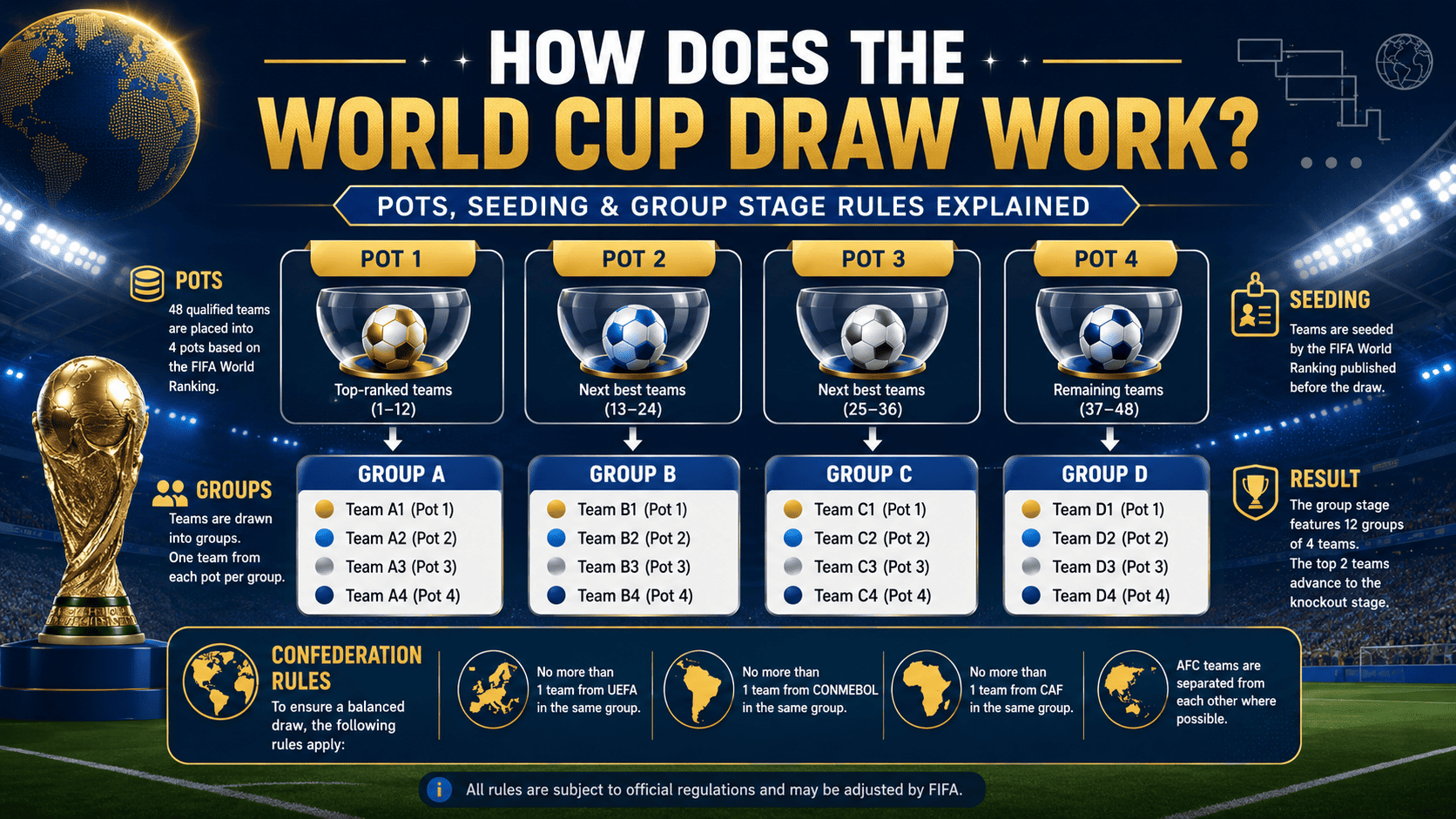
how does the World Cup draw work with pots seeding and group stage rules explained
Draw Element | Simple Meaning |
Pots | Pre-draw buckets used to organize teams |
Seeding | Ranking-based placement before the draw |
Groups | Four-team sections in the group stage |
Confederation rules | Limits on teams from the same region |
Group stage | Three matches per team |
Qualification | Top two plus best third-place teams advance |
Impact | Affects predictions, paths, and World Cup odds |
What Is the World Cup Draw?
The World Cup draw is the event where qualified teams are placed into groups before the tournament begins. It decides which teams face each other in the group stage and starts to shape each team’s possible path through the competition.
The draw is not a simple “pick names from a hat” process. FIFA uses pots, seeding, host allocations, and regional restrictions to guide how teams are placed.
Question | Answer |
What does the draw decide? | Which teams go into each group |
Is it fully random? | No, pots and restrictions apply |
Why does it matter? | It shapes group difficulty and knockout paths |
Is it the same as seeding? | No, seeding helps create the pots before the draw |
Think of the draw as the tournament’s first major turning point. A team can be strong, but a difficult draw can make its route harder. Another team can receive a smoother group and suddenly look more attractive in predictions.
That is why fans, analysts, and betting markets watch the draw closely.
How Does the World Cup Draw Work in 2026?
The 2026 World Cup uses an expanded format. FIFA’s official tournament information confirms a 48-team event hosted across Canada, Mexico, and the United States, with groups, teams, fixtures, and match dates listed through its 2026 tournament hub. The final draw procedures page also explains that teams are organized into pots and allocated into groups under FIFA’s draw rules. You can review the official details through the FIFA World Cup 2026 fixtures, groups and teams page and the FIFA World Cup 2026 Final Draw procedures.
For fans asking “how does the World Cup draw work” in 2026, the key change is the size of the tournament. Instead of 32 teams and eight groups, the event has 48 teams and 12 groups.
2026 Rule | What It Means |
48 teams | More nations than the previous 32-team format |
12 groups | Groups A through L |
Four teams per group | Each team plays three group matches |
Top two advance | 24 teams qualify directly |
Eight best third-place teams | Adds another route into the knockout stage |
Round of 32 | First knockout round in the expanded format |
This format makes the draw more important in several ways. More teams means more variation in group strength. More groups means third-place comparisons matter. A Round of 32 also changes bracket paths, travel demands, and how teams may approach final group matches.
What Are World Cup Pots?
World Cup pots are pre-draw groups of teams. They are used to organize the draw before teams are placed into groups.
The easiest way to understand pots is this: teams are sorted into different buckets so the strongest teams are spread across the tournament instead of all landing in the same group.
Pot | Typical Meaning | Group Impact |
Pot 1 | Hosts and highest-ranked teams | Usually group favorites |
Pot 2 | Strong teams below top seeds | Can create difficult matchups |
Pot 3 | Mid-ranked teams | Can produce upset threats |
Pot 4 | Lower-ranked or playoff teams | Can affect goal difference and third-place races |
A group usually receives one team from each pot. This creates a basic structure: one top seed, one second-tier team, one mid-tier team, and one lower-pot team.
But pots do not guarantee equal groups. Some Pot 2 teams may be almost as strong as Pot 1 teams. Some Pot 3 teams may be dangerous because of recent form, style, or squad strength. Some Pot 4 teams may be difficult to beat even if they are lower-ranked.
Why pots matter for fans
Pots help fans understand why the draw is structured. They also explain why certain teams cannot all be placed in the same group.
Without pots, several elite teams could land together, while another group could be much weaker. Pots reduce that risk, but they do not remove it completely.
How FIFA Seeding Works
FIFA seeding is the process used to organize teams before the draw. In simple terms, stronger or protected teams are placed in higher pots so they can be spread across different groups.
Host teams are also handled specially because the tournament schedule, opening matches, and host placement need to be organized in advance. For 2026, Canada, Mexico, and the United States are co-hosts, which affects how host teams are positioned in the draw structure.
Seeding Term | Meaning |
Seeded team | A team protected by ranking or host status |
Pot 1 | Hosts and top-ranked sides |
FIFA ranking | Official ranking used for draw context |
Draw balance | Goal of spreading top teams across groups |
Limitation | Current strength can differ from ranking |
Seeding is useful, but it is not the same as a perfect strength ranking. A team’s FIFA ranking may not fully capture injuries, tactical changes, manager changes, recent form, or market expectations.
That is why a draw can still produce a difficult group. One team may be lower-seeded but stronger than casual fans expect. Another team may have a high ranking but arrive with poor form or squad issues.
For a deeper explanation of how rankings, Elo, and odds can tell different stories, read Freebetspin’s soccer team ratings guide.
What Are Confederation Restrictions?
Confederation restrictions are regional rules used during the draw. They prevent too many teams from the same football region being placed in the same group.
This helps create geographic balance and avoids groups being overloaded with teams from one confederation.
Confederation Rule | Why It Exists |
Limits teams from the same region | Keeps groups geographically balanced |
UEFA exception | Europe has more qualified teams |
Automatic placement rules | Prevents invalid group combinations |
Host allocation | Keeps tournament logistics organized |
In most World Cup draws, teams from the same confederation are separated where possible. UEFA is usually treated differently because Europe has more teams in the tournament, so some groups can contain more than one European team.
Why restrictions affect the draw
Confederation rules mean the draw is not purely random. If a team is drawn but cannot be placed into a certain group because of regional restrictions, it may move to another valid group.
This is one reason the process can look complicated on television. A ball may be drawn, but placement still has to follow the rules.
For beginners, the important point is simple: pots decide the draw order, while restrictions decide which groups are valid.
How World Cup Group Stage Rules Work
Once the draw creates the groups, the group stage begins. Each group has four teams, and every team plays three matches.
The points system is standard:
Result | Points |
Win | 3 |
Draw | 1 |
Loss | 0 |
Teams are ranked by their group-stage performance. Points come first, but if teams are level, tie-breakers decide the order. FIFA’s group qualification explainer covers how teams qualify from the groups and how tie-breakers are applied. You can read the official overview through FIFA’s World Cup groups and tie-breakers guide.
Common group-stage ranking factors
Ranking Factor | Why It Matters |
Points | Main way teams are ranked |
Goal difference | Separates teams on equal points |
Goals scored | Rewards attacking output |
Head-to-head criteria | Can matter when teams are tied |
Disciplinary record | Cards can affect fair-play tie-breakers |
Draw of lots | Final fallback in rare cases |
The group stage is short. Three matches can create a lot of pressure, especially when several teams are close in quality.
This is why the draw matters. The teams in your group determine the difficulty of those three matches.
How the Best Third-Place Teams Advance
One of the biggest changes in 2026 is the third-place route.
There are 12 groups. That means there will be 12 third-place teams. Eight of those teams advance to the Round of 32, while four are eliminated.
Third-Place Factor | Why It Matters |
Points | Most important first signal |
Goal difference | Can separate teams on equal points |
Goals scored | Rewards attacking output |
Discipline | Cards can matter in tie-breakers |
Results elsewhere | Other groups affect third-place ranking |
This changes how teams approach the final matchday. A team in third place may still have a strong chance to advance with four points. A team on three points may need goal difference. A team with two points may need help from other groups.
Why this matters for predictions
In older formats, third place usually meant elimination. In 2026, third place can still be enough.
That makes group-stage predictions more complicated. A tough draw may not eliminate a strong team immediately, but it can push that team into a less favorable knockout path.
For fans, the key idea is this: finishing first or second is still valuable, even if third place can survive.
Why the World Cup Draw Affects Predictions
The draw affects predictions because it changes opponents, travel, rest, bracket path, and qualification risk.
A team’s tournament outlook can look very different before and after the draw. A favorite placed in a manageable group may have a smoother path. A favorite placed with several strong teams may face more pressure from the start.
Draw Result | Prediction Impact |
Easier group | Higher chance to win the group |
Tougher group | More risk of finishing second or third |
Long travel | More fatigue risk |
Strong Pot 2 team | Favorite faces more pressure |
Balanced group | Draws and goal difference matter more |
Clear bracket path | Futures probability can improve |
This is why World Cup predictions should never rely only on team quality. Tournament path matters.
A team can be excellent but still face a difficult route. Another team can be slightly weaker but benefit from a smoother draw.
For a broader tournament view, Freebetspin’s World Cup predictions and betting guide explains odds, markets, group-stage decisions, predictions, and common betting mistakes.
How the Draw Can Affect World Cup Odds
The draw can affect World Cup odds because odds reflect probability, and probability changes when paths change.
If a strong team receives a favorable group, its outright odds may shorten. If a team lands in a difficult group, its odds may drift because qualification, group position, or knockout route becomes harder.
Draw Outcome | Possible Odds Reaction |
Easier group | Outright odds may shorten |
Tough group | Outright odds may drift |
Favorable knockout route | Title probability may improve |
Hard travel schedule | Market confidence may fall |
Strong opponent in group | Group winner odds may change |
Balanced group | Draw and goal-difference markets matter more |
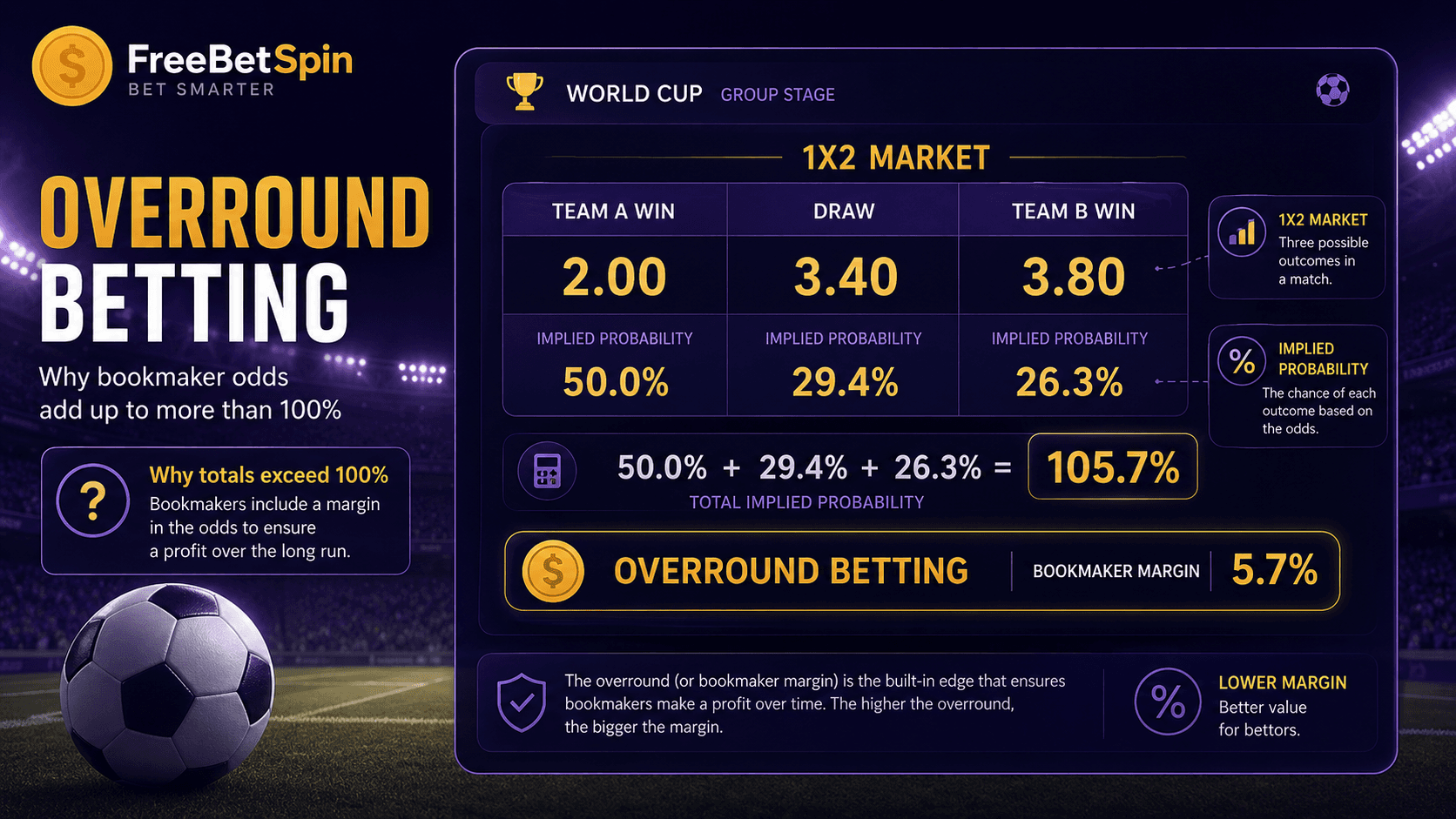
Odds are not pure predictions. They include implied probability, bookmaker margin, market demand, and news. But they can show how the market reacts to the draw.
For example, if a team is placed in a group with two difficult opponents, the market may reduce its chances of winning the group. If that group also creates a harder Round of 32 opponent, outright odds can move as well.
If you are new to odds, Freebetspin’s soccer betting odds explained guide explains how odds, implied probability, favorites, and longshots work.
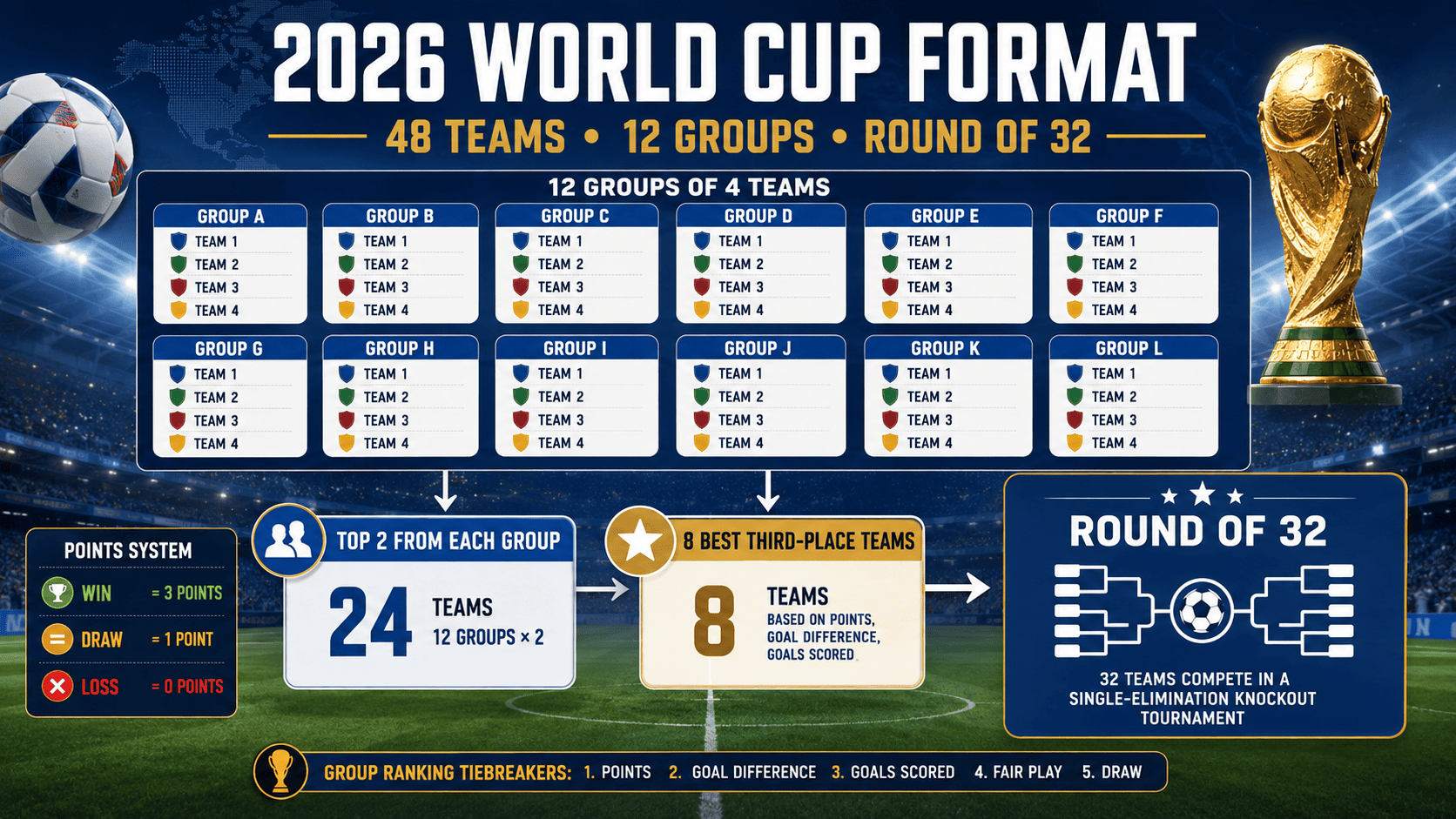
how does the World Cup draw work for 48 teams 12 groups and best third-place qualification
World Cup Draw vs Group of Death: What’s the Difference?
The World Cup draw and the group of death are related, but they are not the same topic.
The draw explains the rules. The group of death explains the result when those rules produce a particularly hard group.
Topic | World Cup Draw Article | Group of Death Article |
Main question | How does the draw work? | Why is one group harder? |
Focus | Rules, pots, seeding, restrictions | Difficulty, imbalance, predictions |
Audience | Beginners learning format | Fans analyzing tough groups |
Main keyword | how does the World Cup draw work | World Cup group of death |
Best use | Understand the process | Judge group difficulty |
A group of death can happen because the draw creates an unusually strong mix of teams. But not every draw result creates a group of death.
For a deeper look at difficult groups, read Freebetspin’s World Cup group of death explained guide.
Common Mistakes Fans Make About the Draw
Many fans misunderstand the draw because it looks random from the outside. In reality, several rules are working at the same time.
Mistake | Better Explanation |
Thinking the draw is fully random | Pots and restrictions shape it |
Thinking Pot 1 always wins the group | Strong lower-pot teams can surprise |
Ignoring third-place qualification | 2026 format changes group strategy |
Confusing seeding with current strength | Rankings can lag behind form |
Assuming easy group means easy tournament | Knockout path also matters |
Ignoring confederation rules | Some teams cannot be placed together |
Another common mistake is assuming the draw only matters for weaker teams. It matters for favorites too.
A favorite wants a group it can control, a schedule that supports recovery, and a knockout path that avoids elite opponents too early. A difficult draw can make every part of that harder.
World Cup Draw Checklist for Beginners
Before judging a draw, use this simple checklist. It helps separate real tournament impact from headline reactions.
Before Judging a Draw | Check |
Which pot did each team come from? | ☐ |
Are there confederation restrictions? | ☐ |
Is one group stronger than others? | ☐ |
Who has the toughest schedule? | ☐ |
Which teams can finish third and still advance? | ☐ |
How does the draw affect the knockout path? | ☐ |
Did odds move after the draw? | ☐ |
This checklist is useful because a draw can look easy at first but become tricky once you account for match order, travel, style, and knockout path.
Quick decision guide
If You Want To Know… | Look At |
Why teams are in certain groups | Pots and confederation rules |
Why a group looks difficult | Team strength and seeding |
Who may advance | Points, tie-breakers, and matchups |
Why odds changed | Group path and market expectation |
Why third place matters | Best third-place qualification rules |
The more you understand the draw, the easier it becomes to read predictions without getting lost in hype.
Conclusion: The Draw Shapes the Whole World Cup Path
The World Cup draw is not just a ceremony. It shapes the tournament before the first match begins.
It decides group opponents, match context, travel demands, and possible knockout paths. Pots and FIFA seeding help balance the tournament, while confederation restrictions prevent invalid regional combinations. The 2026 format adds another layer because 48 teams, 12 groups, and the best third-place qualification route make group-stage strategy more complex.
So, how does the World Cup draw work? It works through structured randomness: teams are sorted into pots, placed into groups under draw rules, and then compete in a group stage where every point, goal, and tiebreaker can matter.
If you understand the draw, you understand the tournament path much better.