

Quick Summary: What a World Cup Group of Death Really Means
A World Cup group of death is a group where several strong teams are drawn together, making qualification much harder than usual. It is not an official FIFA term. It is a fan and media phrase used when a group feels unusually stacked, balanced, or dangerous.
The phrase is usually used when a group has more than one serious contender, a strong lower-seeded team, and very little room for error. In the 2026 World Cup format, group difficulty matters even more because the tournament expands to 48 teams, 12 groups of four, and a new Round of 32. The top two teams from each group advance, along with the eight best third-place teams, so a brutal group can still reshape qualification paths, third-place pressure, and knockout matchups.
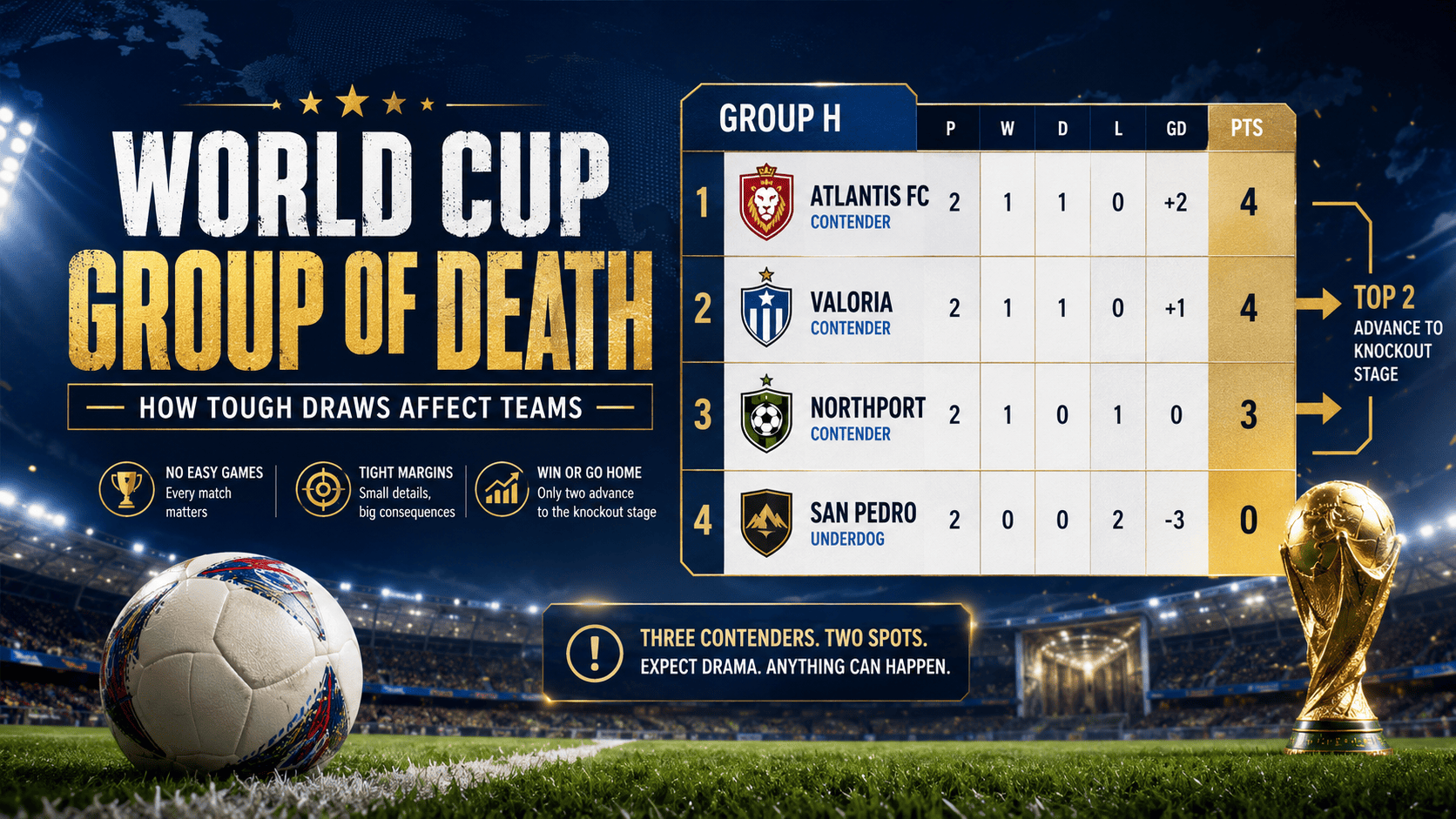
World Cup group of death explained with team strength comparison and group stage structure diagram
Group Signal | Why It Matters |
Multiple strong teams | No easy favorite and fewer safe matches |
Small rating gap | More balanced win/draw/loss probabilities |
Difficult seeding mix | Strong teams from different pots collide |
Tough travel or schedule | Fatigue and recovery become factors |
Tight World Cup odds | Markets see several teams as competitive |
Unclear second-place race | Group-stage predictions become harder |
The best way to understand a World Cup group of death is not by looking only at famous team names. Look at team strength, seeding, Elo ratings, recent form, odds, schedule, and the knockout path.
What Does World Cup Group of Death Mean?
A World Cup group of death means a group where the qualification race is unusually difficult because too many strong teams are competing for limited advancement spots.
In older World Cup formats, the term often meant “three strong teams fighting for two places.” In the 2026 format, the meaning becomes a little more flexible. Because some third-place teams can advance, a group of death may not always eliminate a strong team immediately, but it can still create a brutal path, harder matchups, and higher risk of finishing in a dangerous third-place position.
A tough group usually has one of these patterns:
Group Pattern | Why Fans Call It Dangerous |
Two elite teams plus a strong underdog | One favorite can still slip |
One top seed plus two strong mid-tier teams | The second-place race becomes intense |
Four balanced teams | Every match is close |
Strong tactical contrast | Styles create unpredictable matchups |
Difficult schedule and travel | Recovery and fatigue affect performance |
The phrase is emotional, but the idea can be analyzed. A World Cup group of death is not just about drama. It is about competitive density.
Why fans use the phrase
Fans use “group of death” because it captures the feeling that no team can relax. In a normal group, one elite side may be expected to qualify comfortably. In a group of death, even the favorite may need a result on the final matchday.
That is what makes these groups so popular. They create early tournament tension before the knockout rounds even begin.
How the World Cup Group Stage Works
The modern World Cup group stage is designed to give every team three matches before the knockout rounds. In the 2026 tournament, 48 teams are divided into 12 groups of four. Each team plays the other three teams in its group once.
The basic point system is easy:
Result | Points |
Win | 3 |
Draw | 1 |
Loss | 0 |
After the group stage, group winners, group runners-up, and the eight best third-place teams move into the Round of 32. That creates a bigger knockout bracket than previous 32-team tournaments.
For the official tournament schedule and match structure, see the FIFA World Cup 2026 match schedule.
Why the format increases pressure
Three matches is not many. A team can play well, lose one tight game, and immediately face pressure. A red card, penalty, defensive mistake, or late goal can swing the entire group.
That is why a World Cup group of death feels so intense. The format gives strong teams very little time to fix early problems.
Why third-place qualification changes the story
Because eight third-place teams can advance, finishing third is not always fatal. But it is still risky. A team in a brutal group may finish third with a decent points total, but goal difference, goals scored, discipline records, and results in other groups can become decisive.
This means the World Cup group of death can affect both direct qualification and the quality of a team’s knockout path.
How FIFA Seeding Shapes the Draw
FIFA uses draw pots and procedures to organize teams before the tournament. Seeding is designed to spread stronger teams across groups, but it does not remove imbalance completely.
The 2026 Final Draw procedures and pots are explained by FIFA in its official draw guide. The draw process uses pots, group placement rules, and confederation restrictions to create the group-stage structure. Fans can review the official details in the FIFA World Cup 2026 Final Draw procedures.
Simplified pot system
Pot | General Meaning | Group Impact |
Pot 1 | Hosts and highest-ranked teams | Usually group favorites |
Pot 2 | Strong second-tier teams | Can create tough matchups |
Pot 3 | Mid-range teams | Upset potential |
Pot 4 | Lower-ranked or playoff teams | Often shape goal difference and third-place races |
The problem is that not all teams in the same pot are equal. A dangerous Pot 2 team may be close to Pot 1 quality. A Pot 3 team may be stronger than its ranking suggests. A Pot 4 team may be physically strong, tactically difficult, or underrated by casual fans.
That is how a World Cup group of death can appear even when the draw follows official seeding rules.
Why seeding cannot prevent every tough group
Seeding works best when rankings perfectly reflect current strength. In real soccer, they do not.
A team may be ranked lower because of a difficult qualifying path, a recent transition, fewer high-value fixtures, or inconsistent past results. Another team may rank highly but arrive with injuries, aging players, or poor form.
This gap between official seeding and current strength is where group imbalance begins.
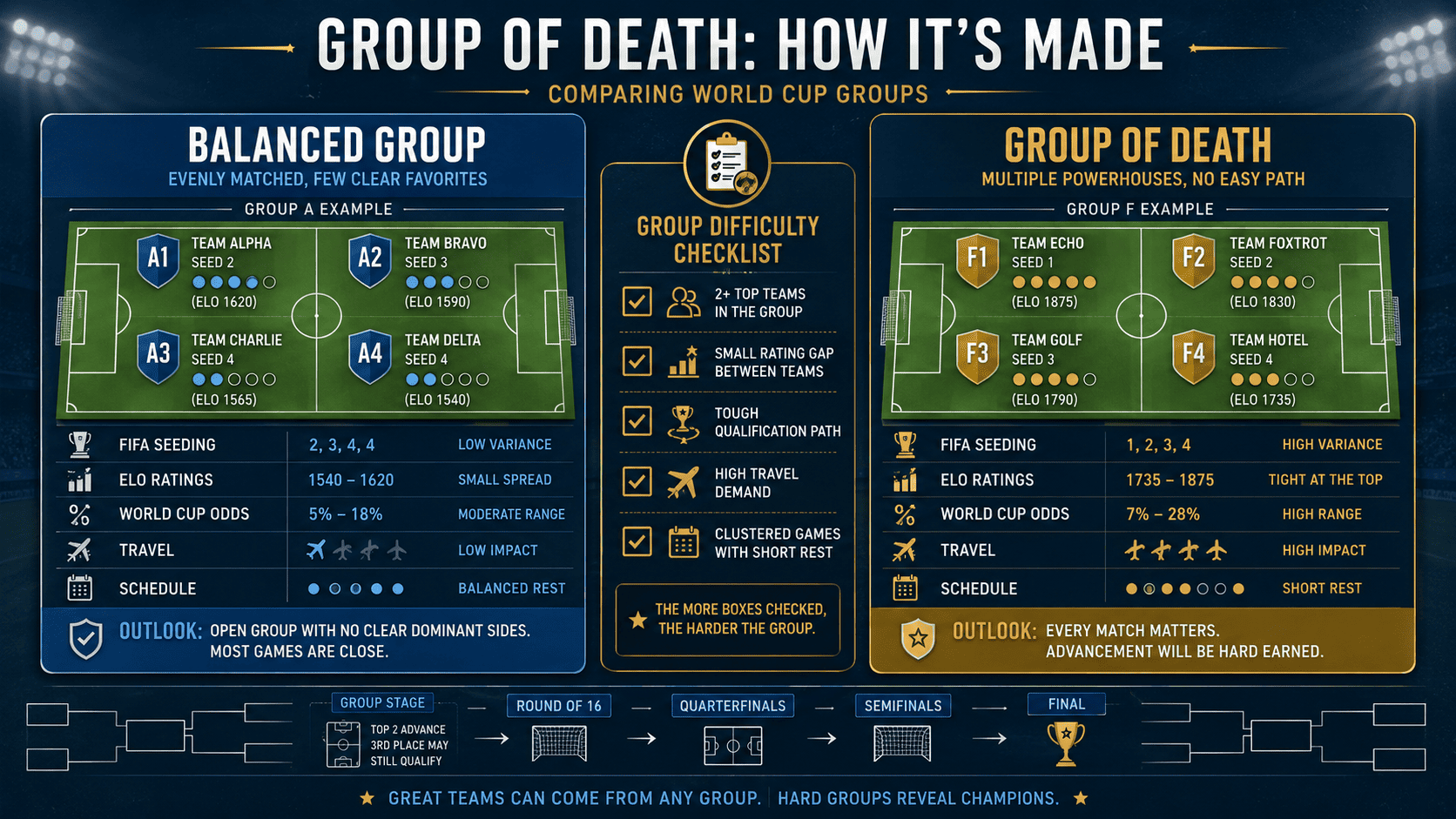
World Cup group of death comparison showing FIFA seeding Elo ratings and group difficulty levels
Why Some Groups Are Still Harder Than Others
Not every tough-looking group is truly a World Cup group of death. Big names help create headlines, but genuine group difficulty comes from how close the teams are in real strength.
A group with one elite team and three weaker teams is not usually a group of death. A group with four competitive teams, or three teams that all expect to qualify, is much more dangerous.
Difficulty Factor | What It Looks Like |
Strength stacking | Several strong teams land together |
Balanced quality | No clear weak team |
Tactical clashes | Styles make matches hard to predict |
Schedule pressure | Key games arrive early or after short rest |
Travel burden | Some teams face harder movement between venues |
Goal difference pressure | Teams must chase goals, not just points |
Strength stacking
Strength stacking happens when several capable teams end up in the same group. This can happen if a lower-pot team is stronger than its seeding, or if a respected team has improved quickly since the ranking period used for the draw.
In these groups, the favorite may still be the best team, but the second, third, and fourth teams are strong enough to punish mistakes.
Tactical matchups
Some groups are hard because of style, not just ranking.
A possession team may struggle against an elite counterattacking side. A technical team may dislike facing a physical pressing team. A defensive underdog may frustrate two stronger teams and steal points.
That is why group-stage predictions should not only compare rankings. They should also consider matchups.
Schedule and travel
In the 2026 World Cup, travel can matter because matches are spread across three host countries and multiple cities. A team’s route, recovery time, and kickoff schedule can affect preparation.
A group becomes tougher when a team faces:
Schedule Issue | Possible Impact |
Short rest between matches | Less recovery time |
Long travel distance | More fatigue |
Early decisive match | Higher pressure from the start |
Final game against direct rival | Qualification may go to the wire |
Heat or weather variation | Tempo and stamina can change |
These details rarely decide everything alone, but they can tilt a close group.
How Elo Ratings Can Measure Group Difficulty
Elo ratings are one way to measure team strength beyond official seeding. The basic idea is simple: teams gain or lose rating points based on results, opponent strength, and match context.
For group difficulty, Elo can help answer three useful questions:
How strong is the average team in the group?
How close are the teams in strength?
Is there a hidden strong team outside Pot 1?
Elo Signal | What It Suggests |
High average Elo | The group is strong overall |
Small Elo gap | The group is balanced |
Strong Pot 3 or Pot 4 team | Upset risk increases |
One dominant Elo team | Clear favorite exists |
Multiple top-rated teams | Group of death risk rises |
A World Cup group of death often appears when the group’s average strength is high and the gap between the second, third, and fourth teams is small.
Why Elo may disagree with FIFA seeding
FIFA rankings and Elo ratings can disagree because they measure team strength differently. FIFA rankings are official and points-based. Elo-style ratings focus heavily on opponent-adjusted results.
That means a team can look better in Elo than in FIFA seeding, or the other way around.
For a deeper explanation of how team ratings compare, read Freebetspin’s soccer team ratings guide.
Why a Tough Group Changes World Cup Odds
A World Cup group of death can change tournament odds because the draw affects a team’s path.
Before the draw, futures odds often reflect squad strength, public demand, historic reputation, and expected tournament performance. After the draw, the market can adjust because some teams receive easier paths while others face tougher routes.
If a strong team lands in a brutal group, its outright odds may drift because:
Qualification becomes less certain
First-place finish becomes harder
Knockout path may become more difficult
Squad rotation becomes harder
Risk of suspensions and fatigue increases
Tough Group Effect | Odds Impact |
Harder qualification | Title probability can fall |
Lower chance to win group | Knockout draw may worsen |
More intense matches | Fatigue and card risk increase |
Stronger third-place risk | Path becomes less predictable |
Public reaction | Market may move quickly after draw |
Why odds are not pure rankings
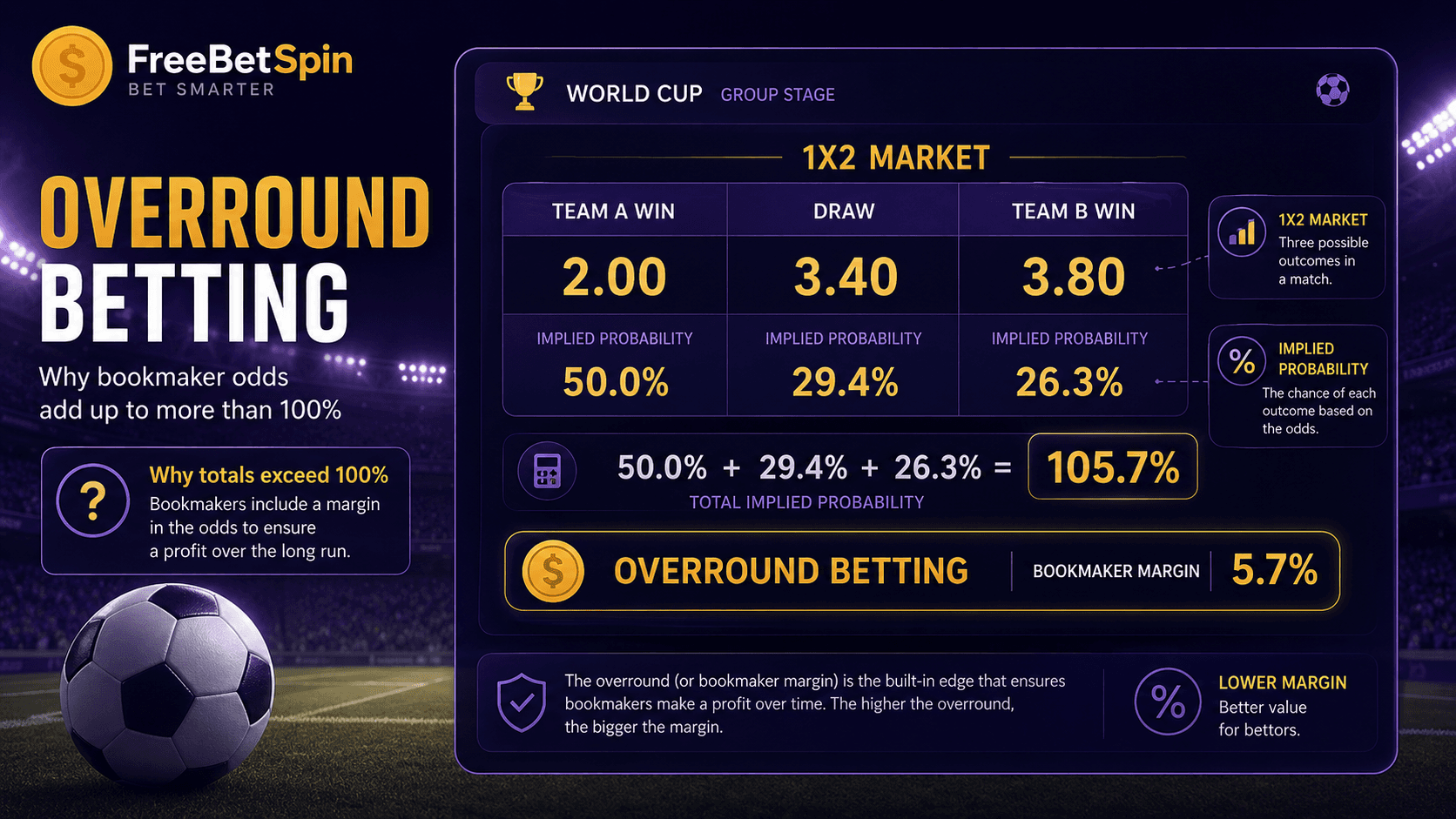
World Cup odds are useful, but they are not perfect team ratings. Odds include implied probability, bookmaker margin, public demand, market movement, and news.
A team can be excellent and still have longer odds if its group is brutal. Another team can be slightly weaker but have shorter odds because it has a smoother path.
To understand how odds show probability and market expectation, read Freebetspin’s soccer betting odds explained guide.
Group Stage Predictions vs Reality
Group-stage predictions are fun, but they are also fragile. The World Cup group stage has a small sample size, and small samples create surprises.
A favorite can dominate the ball, create chances, and draw 1–1. A defensive underdog can score from one set piece. A goalkeeper can have the match of his life. A referee decision can change the group.
Prediction Risk | Why It Matters |
Low-scoring matches | One goal changes everything |
Red cards | Match plans collapse quickly |
Penalties | One event can swing standings |
Goal difference | Late goals affect qualification |
Rotation | Qualified teams may rest players |
Motivation | Teams need different results on matchday three |
Third-place table | Other groups influence risk |
This is why a World Cup group of death is not just about stronger opponents. It is about reduced margin for error.
Why an “easy group” is not always safe
An easier group can still create danger. Favorites sometimes play cautiously, underestimate opponents, or struggle against defensive blocks. Pressure can also be heavier when everyone expects a team to win.
But in a group of death, the danger is more obvious. A strong team may play well and still finish second or third because the competition level is higher.
World Cup Group of Death Examples: What Fans Usually Notice
A World Cup group of death usually becomes clear because fans notice several signals at once.
They see a famous team from Pot 1. Then they see a dangerous Pot 2 opponent. Then they notice a third team with strong recent form, high Elo ratings, or a difficult playing style. Suddenly, the group no longer looks straightforward.
A simple example might look like this:
Team Type | Why It Makes the Group Hard |
Elite favorite | Expected to qualify but faces pressure |
Strong second seed | Good enough to win the group |
Dangerous third seed | Can take points from anyone |
Physical underdog | Can disrupt rhythm and goal difference |
The label is strongest when at least three teams have realistic advancement hopes before the first match is played.
The “two spots” problem
Even with the 2026 third-place route, the top two still matter. Winning the group or finishing second can create a clearer knockout path. Finishing third may mean waiting on results elsewhere and facing a stronger next opponent.
That is why fans still treat group difficulty seriously. Advancement is not only about survival. It is about path quality.
Group Difficulty Checklist for Fans
You can use a simple checklist to judge whether a group deserves the World Cup group of death label.
Question | Why It Matters |
Are there at least two elite-level teams? | Core sign of a hard group |
Is the third team stronger than its seeding? | Upset risk increases |
Is the Elo gap between teams small? | Matches become harder to predict |
Are World Cup odds tightly grouped? | Market sees close competition |
Is there a difficult travel schedule? | Fatigue can matter |
Are playing styles awkward? | Tactical mismatches create risk |
Could third place be dangerous? | Qualification may depend on other groups |
Does second place face a strong knockout path? | Finishing position matters |
If most answers are yes, the group has a strong case.
Simple scoring method
Score | Group Difficulty |
0–2 yes answers | Normal group |
3–4 yes answers | Competitive group |
5–6 yes answers | Very tough group |
7–8 yes answers | Likely World Cup group of death |
This is not an official formula. It is a fan-friendly way to think more clearly about group difficulty.
How Fans Should Read Group of Death Predictions
Group of death predictions can be entertaining, but fans should read them with caution.
A strong prediction should explain why the group is difficult. It should not only list famous countries. It should compare team strength, seeding, Elo ratings, injuries, group schedule, tactical style, and odds.
Good Prediction Includes | Weak Prediction Relies On |
Team strength comparison | Team name recognition |
Draw path analysis | Simple hype |
Odds and ratings context | One opinion |
Schedule and travel notes | No match-by-match logic |
Risk explanation | Guaranteed language |
A smart prediction says, “This group is difficult because these teams are close in quality and the matchups are dangerous.” A weak prediction says, “This group has big names, so it must be deadly.”
For a wider tournament overview, see Freebetspin’s World Cup betting guide, which explains odds, markets, predictions, legal access, and common betting mistakes.
Common Mistakes When Judging a Tough Draw
The biggest mistake is treating reputation as the same thing as current strength. A team may have a famous name but be weaker than past versions. Another team may be less famous but tactically sharp, physically strong, and difficult to beat.
Mistake | Better Approach |
Judging only by famous names | Compare current strength |
Ignoring Pot 3 and Pot 4 teams | Lower seeds can be dangerous |
Forgetting third-place qualification | 2026 format changes risk |
Treating odds as guarantees | Odds show probability, not certainty |
Ignoring travel and schedule | Logistics can affect performance |
Overreacting after one match | Group-stage samples are small |
Assuming easy groups are automatic | Favorites still need results |
Another mistake is assuming every group of death eliminates a favorite. Sometimes a brutal group sharpens strong teams and prepares them for knockout football. Other times it drains them before the tournament really opens up.
That unpredictability is exactly why the phrase remains so popular.
Conclusion: Why the World Cup Group of Death Is More Than a Meme
A World Cup group of death is more than a dramatic label. It is a way to describe a group where strength, seeding, schedule, and pressure combine to make qualification unusually difficult.
The best groups of death are not only about big names. They are about close margins. Several teams can qualify, several can fail, and every match matters.
For fans, these groups create early drama. For analysts, they change prediction models. For betting markets, they can affect World Cup odds, outright prices, and group-stage expectations.
The key lesson is simple: do not judge a group only by reputation. Look at strength, style, ratings, odds, travel, schedule, and knockout path. That is how you spot a real World Cup group of death.