

Quick Summary: Soccer Team Ratings in Plain English
Soccer team ratings are different ways to estimate how strong a team is. FIFA rankings, Elo ratings, betting odds, recent form, analytics, and power rankings can all help explain team strength, but they do not always tell the same story.
That is why World Cup fans sometimes get confused. A team can rank highly in FIFA’s official list, sit lower in Elo ratings, and still have short betting odds. Another team can look strong in recent form but carry longer tournament odds because of injuries, a difficult group, or a tough knockout path.
The simple answer is this: each system measures something slightly different.
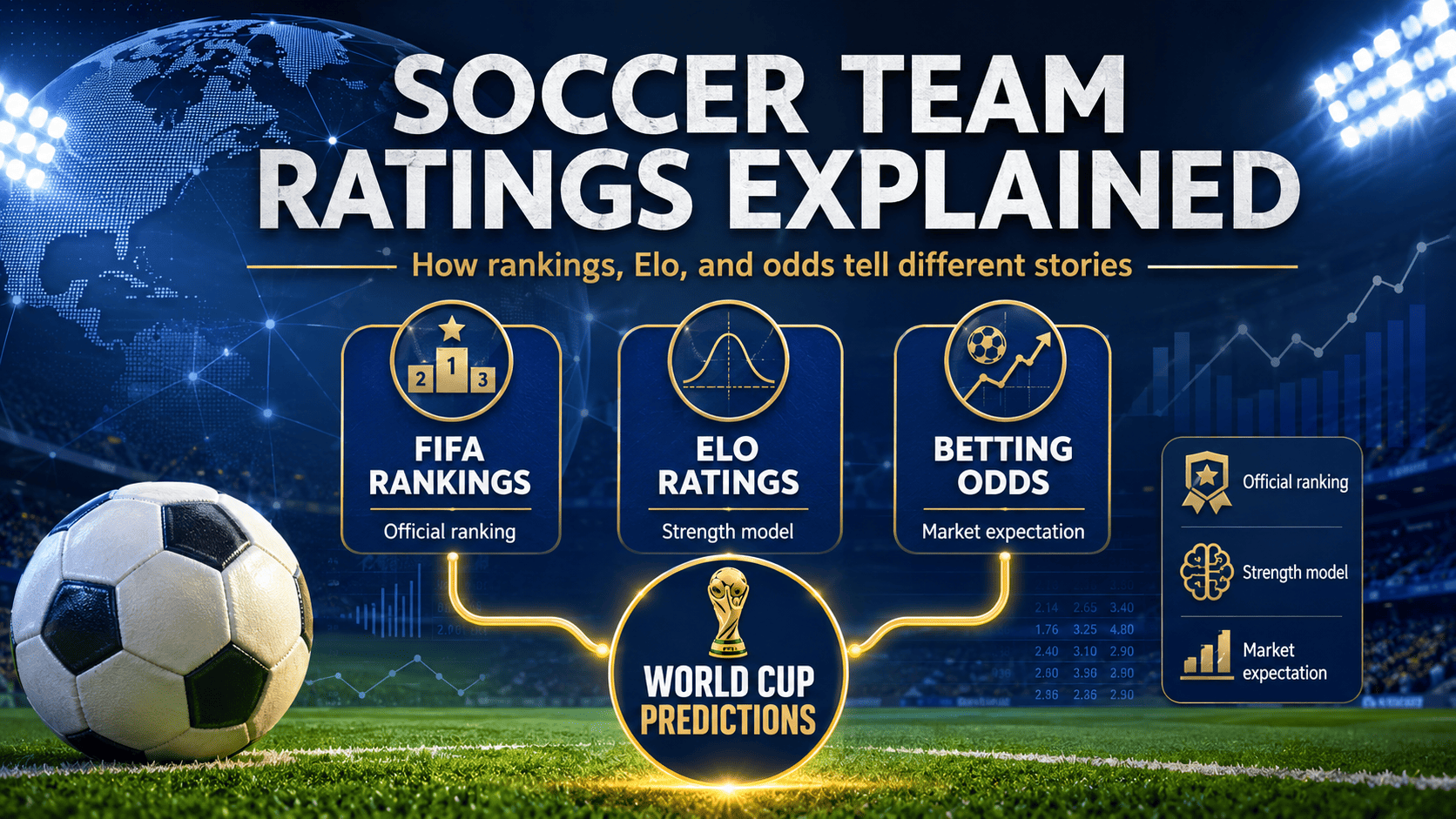
soccer team ratings explained with Elo rankings betting odds and World Cup power rankings
Rating Signal | What It Tells You | Main Limitation |
FIFA Ranking | Official international ranking position | Can lag behind current team strength |
Elo Rating | Strength adjusted by results and opponent quality | Depends on model rules and inputs |
Betting Odds | Market expectation and price | Includes margin, demand, and market movement |
Recent Form | Current momentum | Small samples can mislead |
xG / Analytics | Chance quality and underlying performance | Models can disagree |
Power Rankings | Overall team order for fans | Often subjective or method-dependent |
The smartest approach is not to trust one ranking blindly. Use soccer team ratings as a map, then add context: injuries, lineup news, group draw, tournament path, odds movement, and match style.
What Are Soccer Team Ratings?
Soccer team ratings are systems that try to answer one question: how strong is this team compared with other teams?
Some ratings are official. Some are mathematical. Some come from betting markets. Some are made by analysts, journalists, or fans. They can all be useful, but only if you understand what each one is trying to measure.
Type of Rating | Example | How It Works |
Official ranking | FIFA ranking | Uses official international match results and a points formula |
Elo-style rating | Elo ratings soccer models | Updates after matches based on result and opponent strength |
Market-based rating | Betting odds | Converts market prices into implied expectations |
Analytics rating | xG or model-based rankings | Uses chance quality, shots, expected goals, and performance data |
Editorial ranking | Soccer power rankings | Uses expert judgment, form, injuries, and tournament context |
A good rating system helps you organize information. It does not remove uncertainty. Soccer is too low-scoring and too unpredictable for any ranking to guarantee the next result.
Why Soccer Team Ratings Matter for World Cup Predictions
World Cup predictions are hard because the tournament format changes everything. A team’s raw quality matters, but so does its group, travel schedule, squad health, tactical matchups, and potential knockout route.
That is where soccer team ratings help. They let you compare teams before emotion, reputation, or one dramatic result takes over.
Prediction Question | How Ratings Help |
Who are the real favorites? | Compare odds, Elo, squad strength, and recent form |
Which group is hardest? | Look at the average rating strength across the group |
Which underdog is dangerous? | Find teams with strong Elo or analytics but less public hype |
Which team may be overrated? | Compare ranking position with odds, form, and squad news |
Who has the easier path? | Combine team strength with group draw and bracket route |
If you want a broader tournament view, Freebetspin’s World Cup predictions and betting guide explains how odds, markets, predictions, bonus terms, and common betting mistakes fit together.
FIFA Rankings vs Elo Ratings
FIFA rankings and Elo ratings are two of the most common ways fans compare national teams.
FIFA rankings are the official international rankings. They matter for prestige, seeding context, and global comparison. FIFA explains its men’s ranking procedure through a points-based method that accounts for match results, expected results, and match importance. You can read the official explanation on the FIFA/Coca-Cola Men’s World Ranking procedure.
Elo ratings are model-based strength ratings. The core idea is simple: beating a strong opponent is worth more than beating a weak opponent, and losing to a weaker opponent hurts more than losing to an elite team.
Feature | FIFA Rankings | Elo Ratings |
Main use | Official global ranking | Strength estimation |
Update logic | FIFA points formula | Rating changes after results |
Opponent strength | Included | Central to the model |
Match importance | Included | Usually included in soccer variants |
Easy for fans? | Yes, because the list is official | Medium, because models vary |
Best use | Official standing and seeding context | Team strength comparison |
A useful way to think about it: FIFA rankings are the official scoreboard of international standing. Elo ratings are more like a strength meter that reacts to who you beat and who you lose to.
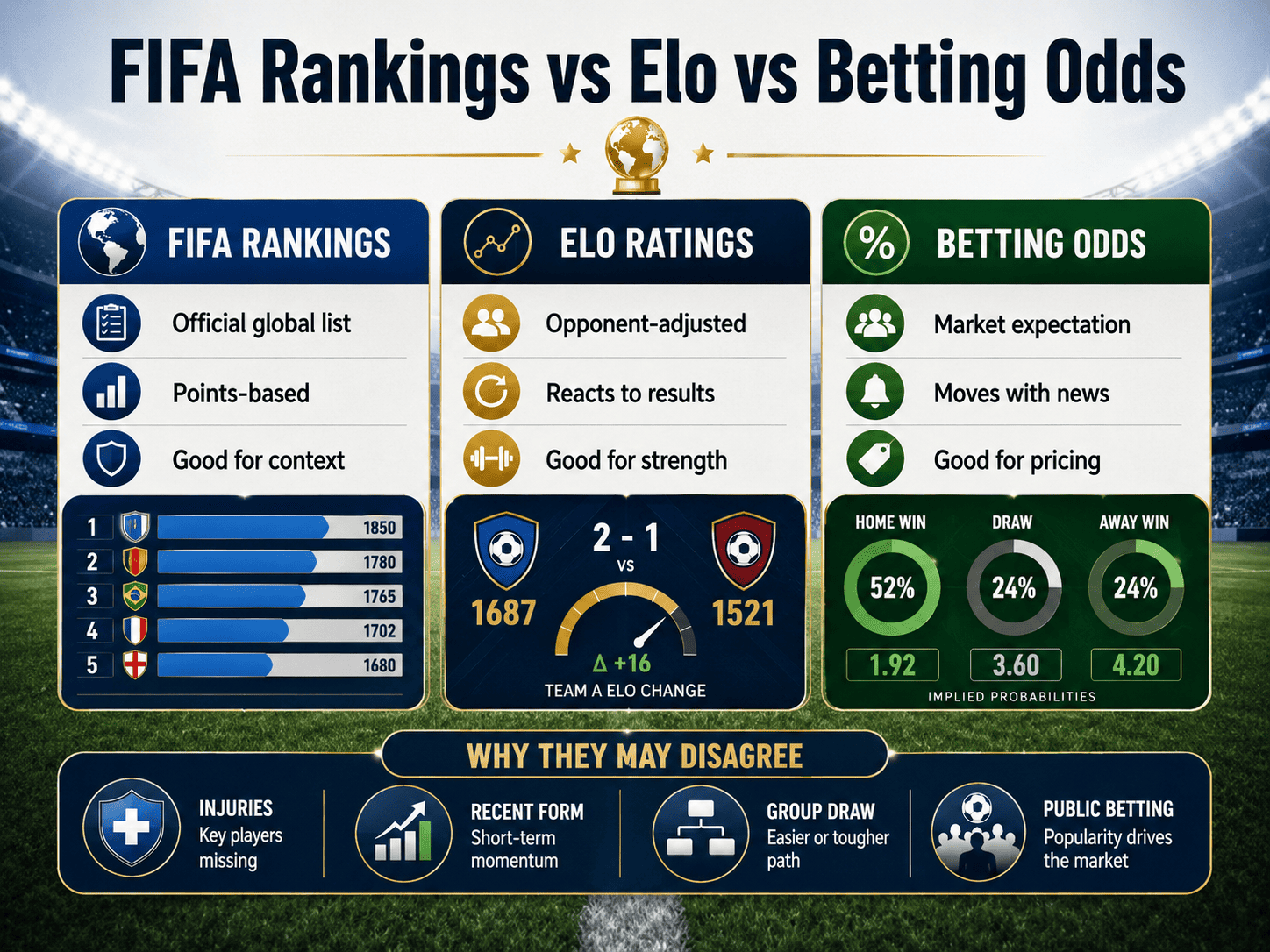
soccer team ratings comparison showing FIFA rankings Elo ratings and betting odds predictions
FIFA Top 20 vs Elo Top 20: What the Data Shows
FIFA rankings and Elo rankings often overlap near the top, but they do not match perfectly. That is where soccer team ratings become interesting.
A June 2026 FIFA ranking snapshot listed Argentina, Spain, France, England, Portugal, and Brazil as the top six. A June 3, 2026 Elo snapshot had Spain first, followed by Argentina, France, England, Brazil, and Portugal.
That is not a contradiction. It is a reminder that each system weighs results and strength differently.
Rank | FIFA Ranking Snapshot | Elo Rating Snapshot |
1 | Argentina | Spain |
2 | Spain | Argentina |
3 | France | France |
4 | England | England |
5 | Portugal | Brazil |
6 | Brazil | Portugal |
7 | Morocco | Colombia |
8 | Netherlands | Netherlands |
9 | Belgium | Ecuador |
10 | Germany | Germany |
11 | Germany | Norway |
12 | Croatia | Croatia |
13 | Italy | Japan / Türkiye |
14 | Colombia | Japan / Türkiye |
15 | Mexico | Switzerland |
16 | Senegal | Uruguay |
17 | USA | Belgium |
18 | Japan | Mexico / Senegal |
19 | Switzerland | Mexico / Senegal |
20 | IR Iran | Denmark |
This table is useful because it shows how one team can be viewed differently depending on the system. Morocco, for example, ranked very high in the FIFA snapshot, while Elo placed teams like Colombia and Ecuador higher than many casual fans might expect.
For readers, the practical takeaway is simple: do not use one list as the whole story.
Why Match Results Can Be Noisy
Soccer results can be noisy. A team can play well and lose. A team can play poorly and win. One red card, penalty, deflection, or goalkeeper mistake can change the entire result.
That is why soccer team ratings should not be read as exact truth. They are summaries of information.
Noisy Factor | Why It Matters |
Red cards | Change match state quickly |
Penalties | One event can swing the score |
Low scoring | One goal can decide the match |
Rotation | Strong teams may rest players |
Friendly matches | Intensity can vary |
Injuries | Squad quality changes |
Tactical matchups | Styles can distort results |
Small samples | A few matches can mislead |
This is also why analysts use extra signals such as xG, shot quality, squad availability, and tournament context. Freebetspin’s xG soccer betting guide explains how expected goals can help you look beyond the scoreline.
Why Betting Odds Reflect Market Expectations
Betting odds are not pure soccer team ratings, but they are a powerful market signal. If a team has short World Cup winner odds, the market is treating it as a serious contender.
Outright odds can reflect team quality, public betting demand, injuries, squad depth, draw path, and bookmaker margin. They are not simply a list of the “best teams,” but they do show how the market prices future chances.
A June 2026 World Cup outright market snapshot showed Argentina, France, England, Spain, and Brazil among the leading title favorites. The same market listed Germany, Portugal, Netherlands, Belgium, and the USA among the next group of shorter prices.
Market-Implied Contender Signal | Example From Outright Odds |
Top favorite tier | Argentina, France, England, Spain, Brazil |
Strong contender tier | Germany, Portugal, Netherlands |
Popular outsider tier | Belgium, USA |
Longshot tier | Teams with much longer outright prices |
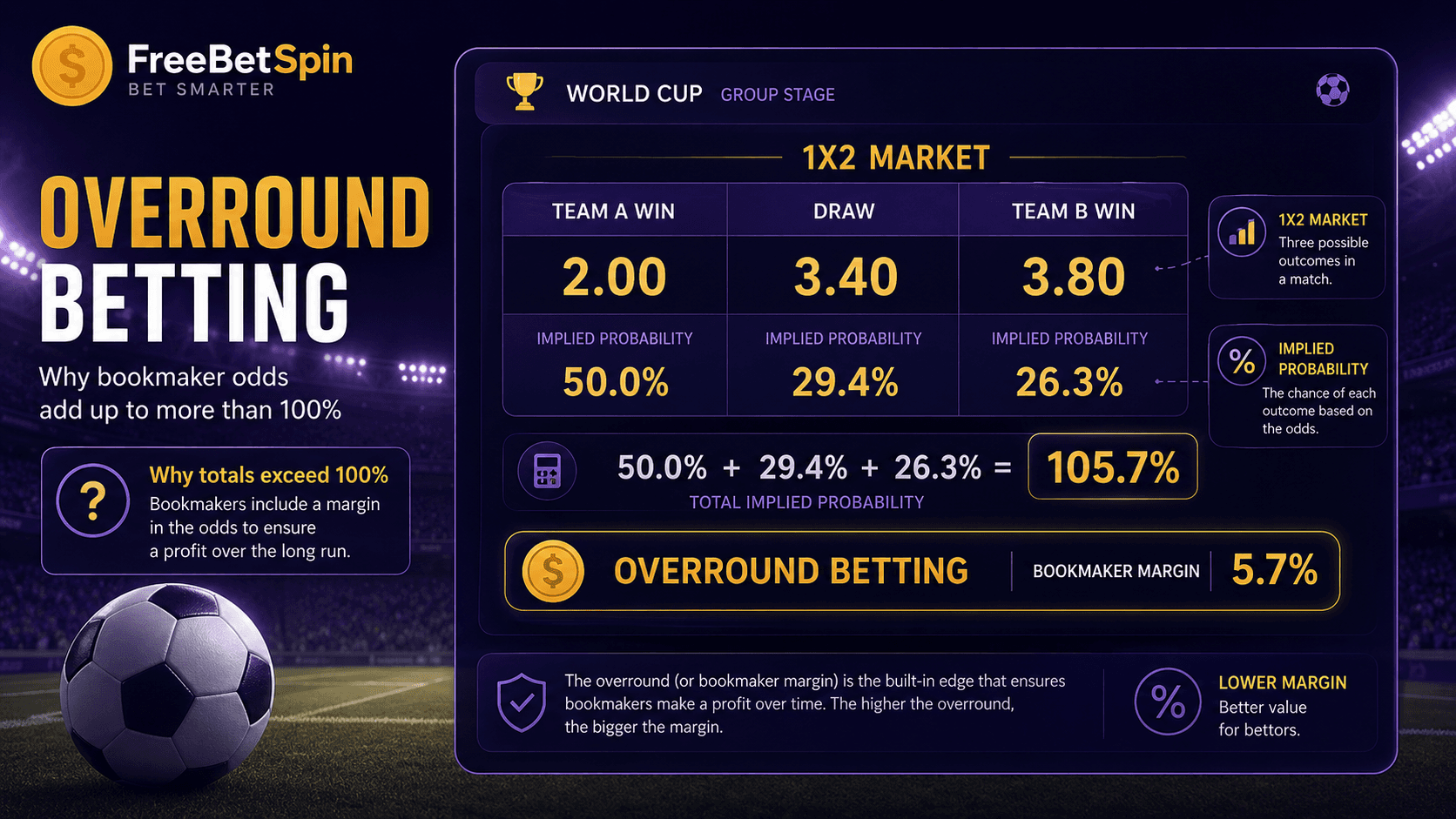
Odds should be read carefully. A shorter price does not guarantee success. It means the market is assigning a higher implied chance than it is giving to longer-priced teams.
To understand how odds turn into probability, read Freebetspin’s soccer betting odds explained guide.
How Odds-Based Soccer Team Ratings Work
Odds-based soccer team ratings start with betting prices. Analysts can convert those prices into implied probabilities, adjust for bookmaker margin, and compare teams by market expectation.
You do not need to build a full model to understand the idea. If Team A has much shorter World Cup winner odds than Team B, the market is giving Team A a higher chance of winning the tournament.
Step | What Happens |
1 | Collect market odds for each team |
2 | Convert odds into implied probability |
3 | Account for bookmaker margin |
4 | Compare teams by market-implied chance |
5 | Add context such as injuries, draw path, and squad depth |
This is useful because odds can react quickly. If a star player gets injured, if a team receives a favorable draw, or if a market moves heavily toward one side, odds can update faster than official rankings.
But odds-based ratings have limits. They include bookmaker margin and public demand. A popular national team may attract money because fans want to back it, not only because the team is objectively stronger.
Why Rankings and Odds May Disagree
This is the main thing fans need to understand: rankings and odds are not answering the exact same question.
FIFA rankings ask, “How has this team performed under the official ranking system?”
Elo asks, “How strong is this team after adjusting for opponents and results?”
Odds ask, “What chance is the market pricing right now?”
Those are related, but not identical.
Reason for Disagreement | Example |
FIFA rankings reward official results over time | A consistent team may rank high |
Elo reacts differently to opponent strength | Beating strong teams matters more |
Odds price future expectations | Injuries and draw path matter |
Public demand can influence prices | Popular nations may shorten |
Recent squad changes matter | New manager or injuries affect odds |
Group draw changes chances | Easier path can shorten outright odds |
Ratings update at different speeds | Markets can move faster than official lists |
A team may rank high in FIFA but carry longer World Cup odds because its tournament path is difficult. Another team may sit lower in FIFA but have shorter odds because the market likes its squad depth, draw, or recent performance.
That disagreement is not a problem. It is the interesting part.
FIFA Rankings vs Elo vs Odds: Which Should You Trust?
There is no single “best” rating for every question. The better approach is to match the tool to the question.
If You Want To Know… | Better Signal |
Official global standing | FIFA rankings |
Long-term strength | Elo ratings |
Market expectation today | Betting odds |
Current performance | Recent results and xG |
Tournament path | Group draw and bracket |
Betting price | Odds and implied probability |
Squad reliability | Injuries, depth, and rotation risk |
A team that looks strong across several systems is usually easier to trust than a team that only looks strong in one. If a team has a high FIFA ranking, strong Elo rating, short odds, good recent xG, and a healthy squad, the signal is more convincing.
If the signals are mixed, slow down. That does not mean the team is bad. It means the case needs more context.
How to Build a Simple Soccer Power Ranking
A soccer power ranking is an ordered list of teams based on current perceived strength. It can be built with data, expert judgment, or a mix of both.
For a World Cup power ranking, the best version should not copy FIFA rankings, Elo ratings, or betting odds directly. It should combine several signals.
Factor | Example Weight | Why It Matters |
Elo / strength rating | 30% | Baseline team quality |
Betting odds | 25% | Market expectation |
Recent form | 15% | Current momentum |
Squad depth | 15% | Tournament durability |
Draw path | 10% | Easier or harder route |
Injury news | 5% | Short-term adjustment |
This is not an official formula. It is a simple example of how fans can think. You can adjust the weights depending on what matters most to you.
For example, if you care about the World Cup specifically, draw path may deserve more weight. If you care about long-term team strength, Elo may deserve more.
What Fans Should Watch Before Making Predictions
Before you trust any ranking, ask what it includes and what it leaves out.
A clean number can feel convincing, but soccer has context. A team’s ranking may not fully reflect a new coach, tactical change, injured star, or brutal group draw.
Before Trusting a Ranking | Check |
Is it official, model-based, market-based, or editorial? | ☐ |
Does it account for opponent strength? | ☐ |
Does it reflect current injuries? | ☐ |
Does it consider group path? | ☐ |
Does it include market odds or only past results? | ☐ |
Has the team changed manager or tactics? | ☐ |
Is the sample size meaningful? | ☐ |
Are you using rankings as support, not certainty? | ☐ |
This matters even more during a tournament. A World Cup can move quickly. A team may look average in rankings but match up well with its group. Another team may look elite but face travel, rotation, or injury problems.
Common Mistakes When Reading Soccer Team Ratings
The biggest mistake is treating one ranking as a prediction. Rankings are helpful, but they do not replace matchup analysis.
Mistake | Better Approach |
Treating FIFA ranking as a prediction | Use it as one signal |
Ignoring odds movement | Market expectations can update fast |
Assuming short odds mean guaranteed success | Odds show probability, not certainty |
Trusting one ranking blindly | Compare multiple signals |
Ignoring draw path | World Cup structure matters |
Overreacting to one result | Soccer is noisy |
Forgetting bookmaker margin | Odds include pricing margin |
Are you using rankings as support, not certainty? | ☐ |
The second mistake is assuming disagreement means one system is “wrong.” A FIFA ranking, Elo rating, and betting market can all be reasonable while still giving different answers.
The better question is not “which one is perfect?” It is “what is this system telling me, and what is it missing?”
Conclusion: Ratings Explain Team Strength, Not Certainty
Soccer team ratings help fans understand team strength, but they do not make soccer predictable.
FIFA rankings provide the official global list. Elo ratings offer an opponent-adjusted strength view. Betting odds show market expectations. xG and recent form help explain current performance. Power rankings combine these signals into a more flexible fan-friendly order.
For World Cup predictions, the best approach is to use multiple signals together. A team that looks strong in FIFA, Elo, odds, squad depth, and recent performance is easier to trust than a team that only looks good in one metric.
Use ratings to ask better questions. Do not use them as guarantees.