

Quick Summary: Craps House Edge Explained
Craps house edge is the casino’s long-term advantage on a specific craps bet. The important thing to know is that not all craps bets are equal. Some bets, such as Pass Line and Don’t Pass, are relatively player-friendly. Others, especially many center-table proposition bets, can carry a much higher edge.
The Pass Line bet is one of the easiest starting points for beginners, with a commonly cited house edge of about 1.41%. The Don’t Pass bet is slightly lower at about 1.36%, though some players avoid it because it bets against the shooter. Come and Don’t Come bets work in a similar way once a point is established.
Odds bets are the special part of craps. They pay true odds and have no built-in house edge on the odds portion, but they must be placed behind an existing Pass Line, Don’t Pass, Come, or Don’t Come bet. A simple craps strategy starts with understanding these low-edge bets before chasing high-payout options.
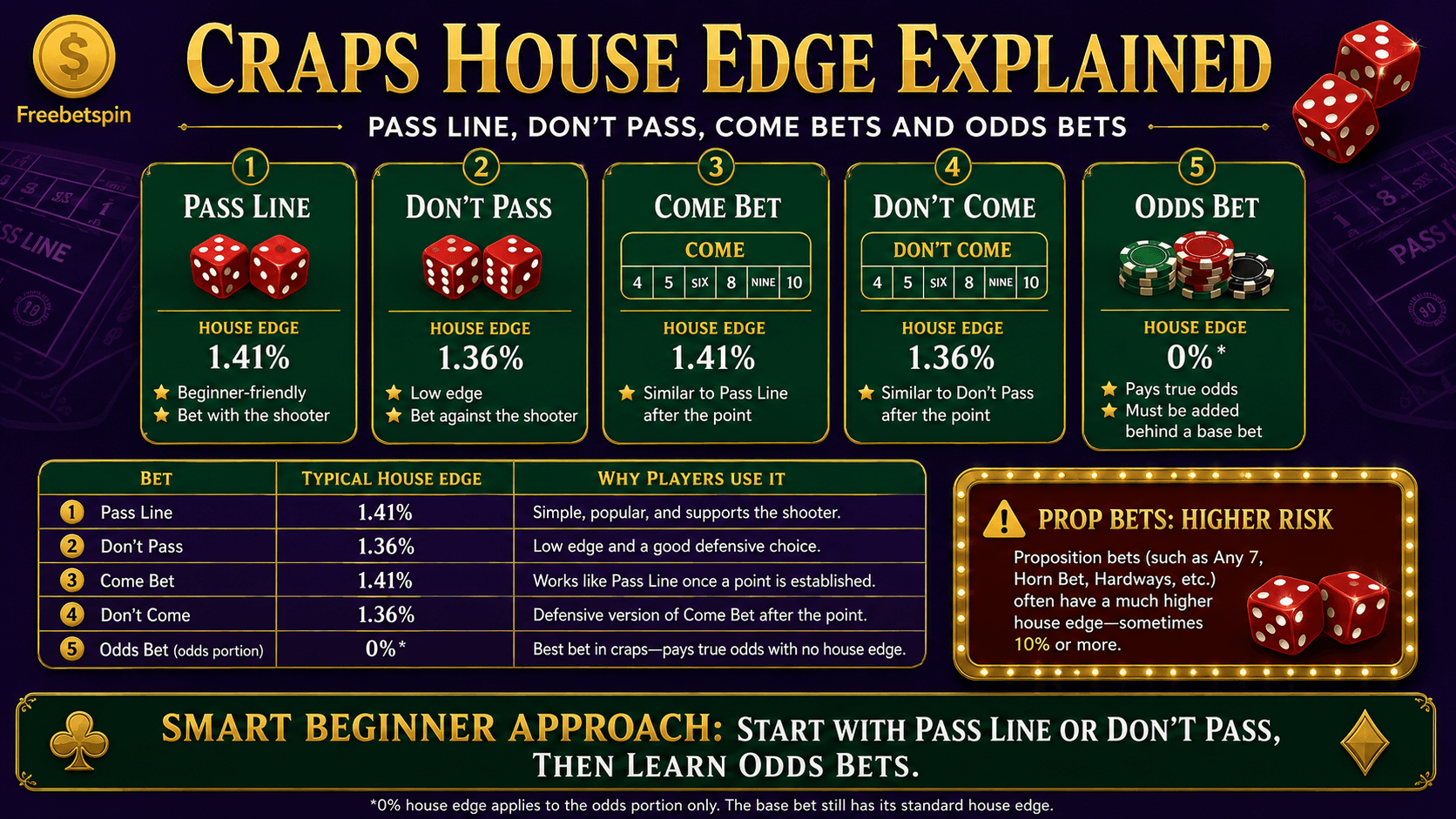
craps house edge comparison for Pass Line Don’t Pass Come and Odds bets
What Is Craps House Edge?
Craps house edge is the casino’s average mathematical advantage on a craps bet over many rolls. It is usually shown as a percentage of the amount wagered.
This does not mean you will lose that exact percentage in one short session. You might hit a good roll, lose quickly, or move up and down for a while. The edge matters most over repeated bets because it shows how favorable or unfavorable each wager is in the long run.
The key point is that every craps bet has its own house edge. A Pass Line bet is not the same as a hardway bet. An Odds bet is not the same as a one-roll proposition bet. The table may look like one big game, but each area of the layout has a different risk profile.
Term | Simple Meaning | Why It Matters |
Craps house edge | Casino’s long-term advantage on a bet | Lower is better for players |
Craps odds | Probability of dice outcomes | Helps compare bet value |
Pass Line bet | Bet with the shooter | Common beginner starting point |
Don’t Pass bet | Bet against the shooter | Slightly lower edge, less social |
Odds bet | Extra bet behind a base bet | Pays true odds |
Proposition bet | Usually a center-table special bet | Often higher risk |
A high payout does not automatically mean a good bet. Some bets pay more because they are much harder to hit. A good beginner approach is to understand the core low-edge bets first, then decide whether any higher-risk options fit your budget and play style.
How Craps House Edge Works
Craps is based on two dice, and two dice do not create every total equally. This is the first thing that makes craps odds easier to understand.
There is only one way to roll a 2: one die shows 1 and the other also shows 1. There are six ways to roll a 7: 1-6, 2-5, 3-4, 4-3, 5-2, and 6-1. That makes 7 the most common total in the game.
Dice Total | Number of Combinations | Simple Frequency Note |
2 | 1 | Rare |
3 | 2 | Low |
4 | 3 | Medium-low |
5 | 4 | Medium |
6 | 5 | High |
7 | 6 | Highest |
8 | 5 | High |
9 | 4 | Medium |
10 | 3 | Medium-low |
11 | 2 | Low |
12 | 1 | Rare |
The craps house edge comes from the difference between the true probability of an outcome and the payout offered by the casino. If a bet pays less than the true risk would require, the casino has an edge.
This is why the same dice roll can be good for one bet and bad for another. A 7 can win on the come-out roll for Pass Line, but it can also end a point cycle later. Craps looks chaotic at first, but the game becomes much easier when you think in terms of bet type, timing, and payout.
For a broader explanation of how random outcomes and probability work, this guide to probability theory offers useful background.
Pass Line Bet House Edge
The Pass Line bet is the most common beginner-friendly craps bet. It is a bet with the shooter, which means you are hoping the shooter succeeds.
On the come-out roll, the Pass Line wins if the shooter rolls 7 or 11. It loses if the shooter rolls 2, 3, or 12. If the shooter rolls 4, 5, 6, 8, 9, or 10, that number becomes the point.
Once the point is set, the shooter must roll the point again before rolling 7. If the point repeats first, the Pass Line wins. If 7 rolls first, the Pass Line loses.
Stage | Roll Result | Pass Line Outcome |
Come-out roll | 7 or 11 | Wins |
Come-out roll | 2, 3, or 12 | Loses |
Come-out roll | 4, 5, 6, 8, 9, or 10 | Point is established |
After point | Point rolls before 7 | Wins |
After point | 7 rolls before point | Loses |
The standard Pass Line bet has a commonly cited house edge of about 1.41%. That makes it one of the better-known low-edge craps bets and a sensible place for beginners to start.
A Pass Line bet is also easy to follow socially. Most players at the table are cheering for the shooter, so beginners often find this bet more natural than betting against the roll.
Don’t Pass Bet House Edge
The Don’t Pass bet is the opposite of the Pass Line bet. Instead of betting with the shooter, you are betting that the shooter will fail to make the point.
On the come-out roll, Don’t Pass wins on 2 or 3 and loses on 7 or 11. A roll of 12 is usually a push, meaning your bet is returned. If a point is established, Don’t Pass wins if 7 rolls before the point.
Stage | Roll Result | Don’t Pass Outcome |
Come-out roll | 2 or 3 | Wins |
Come-out roll | 7 or 11 | Loses |
Come-out roll | 12 | Usually push |
Come-out roll | 4, 5, 6, 8, 9, or 10 | Point is established |
After point | 7 rolls before point | Wins |
After point | Point rolls before 7 | Loses |
The standard Don’t Pass bet has a commonly cited house edge of about 1.36%. That is slightly lower than Pass Line, which makes it attractive from a mathematical perspective.
However, Don’t Pass can feel less social because it wins when many other players lose. This does not make it wrong, but beginners should understand the table mood. If you prefer cheering with most of the table, Pass Line may feel more comfortable. If your focus is strictly on craps house edge, Don’t Pass is worth learning.
Come and Don’t Come Bets
Come and Don’t Come bets work like Pass Line and Don’t Pass bets, but they start after a point has already been established.
A Come bet is similar to a new Pass Line bet. The next roll acts like its own come-out roll for that bet. A 7 or 11 wins, while 2, 3, or 12 loses. If another number rolls, that number becomes the come point.
A Don’t Come bet works like a Don’t Pass bet after the main point is established. It wins on 2 or 3, loses on 7 or 11, and usually pushes on 12. If a come point is set, Don’t Come wins if 7 rolls before that come point.
Bet Type | Similar To | When It Starts | Beginner Note |
Come bet | Pass Line | After a point is established | Creates a new come point |
Don’t Come bet | Don’t Pass | After a point is established | Bets against the new come point |
Come Odds | Odds behind Come | After come point is set | Pays true odds |
Don’t Come Odds | Odds behind Don’t Come | After come point is set | Pays true odds |
Come and Don’t Come bets are useful because they let players create more point-style action. They also allow Odds bets after the come point is set.
For beginners, it is best to understand Pass Line and Don’t Pass first. Once those feel clear, Come and Don’t Come become much easier to follow.
Why Odds Bets Are Different
Odds bets are one of the most important concepts in craps because they are different from most casino bets. An Odds bet is an extra bet placed behind a Pass Line, Don’t Pass, Come, or Don’t Come bet after a point is established.
The special thing about an Odds bet is that it pays true odds. That means the payout matches the actual probability of the dice outcome. Because of that, the Odds portion of the wager has no built-in casino edge.
This does not mean the entire bet has no edge. The original Pass Line, Don’t Pass, Come, or Don’t Come bet still has a house edge. The Odds bet simply improves the overall value of the combined wager.
What True Odds Mean in Craps
Point Number | True Odds Against Making Point Before 7 | Typical Odds Payout |
4 or 10 | 2:01 | Pays 2:1 |
5 or 9 | 3:02 | Pays 3:2 |
6 or 8 | 6:05 | Pays 6:5 |
For example, if the point is 4, there are three ways to roll 4 and six ways to roll 7. That creates true odds of 2:1 against making the point before 7. The Odds bet pays accordingly.
Odds bets can be strong value, but they also increase how much money you have on the table. A beginner should not take maximum odds just because the math is good. Good value still carries real bankroll swings.
Pass Line + Odds vs Don’t Pass + Odds
Pass Line + Odds is one of the most common beginner-friendly craps approaches. You place a Pass Line bet, wait for a point, then add an Odds bet behind it.
This keeps the structure simple. You are still betting with the shooter, but you add a true-odds wager once the point is set.
Don’t Pass + Odds works in the opposite direction. You start with Don’t Pass, then lay odds after the point is established. This can be slightly stronger mathematically, but it may feel less social because you are betting against the shooter.
Strategy | Base Bet | Odds Bet | Player Experience |
Pass Line + Odds | Pass Line | Behind Pass Line | Simple, social, beginner-friendly |
Don’t Pass + Odds | Don’t Pass | Laid behind Don’t Pass | Lower edge, less social |
Come + Odds | Come | Behind Come | Adds more point-style action |
Don’t Come + Odds | Don’t Come | Behind Don’t Come | More advanced “dark side” play |
The best choice depends on your comfort level. If you are new, Pass Line + single Odds is often easier to learn. If you care more about the lowest available craps house edge and do not mind betting against the shooter, Don’t Pass + Odds is worth understanding.
Before choosing an online casino-style platform, compare game options, rules, payment features, and safety signals in our guide to the Best Legit Social Casinos 2026.
High House Edge Craps Bets to Understand
Craps has many exciting bets in the center of the table. These can include proposition bets such as Any 7, Any Craps, Horn bets, and other one-roll wagers.
These bets are popular because they can resolve quickly and sometimes offer large payouts. The tradeoff is that many of them carry a much higher craps house edge than Pass Line, Don’t Pass, Come, Don’t Come, or Odds bets.
Bet Type | Why It Looks Attractive | Beginner Caution |
Any 7 | Wins if the next roll is 7 | Often high house edge |
Any Craps | Wins on 2, 3, or 12 | One-roll volatility |
Hardways | Pays more on paired totals | Can lose multiple ways |
Horn bet | Covers several rare totals | Complex and volatile |
Field bet | Simple one-roll bet | Rules and payouts vary |
These bets are not automatically forbidden. Some players enjoy using small amounts for entertainment. The problem comes when beginners treat high-payout bets as a main craps strategy.
A better approach is to think of proposition bets as optional extras. Keep them small, understand the payout, and do not confuse a big payout with strong value.
Beginner-Friendly Craps Strategy
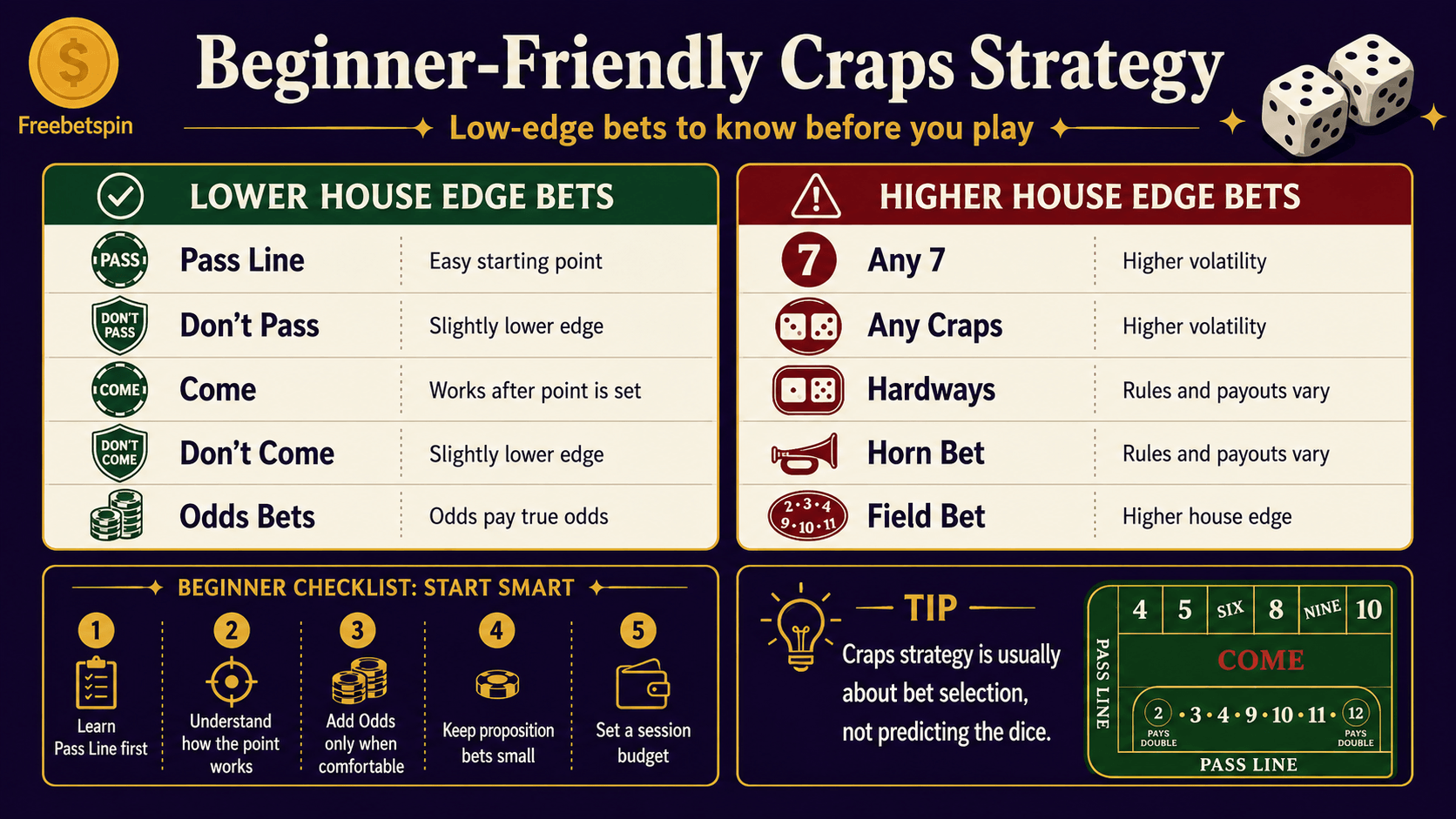
craps house edge beginner strategy showing low edge and high edge craps bets
A beginner-friendly craps strategy does not need to cover the whole table. In fact, trying to play too many bets at once is one of the fastest ways to get confused.
Start with the Pass Line bet. It is easy to follow, has a relatively low house edge, and keeps you aligned with the shooter. Once you understand the point cycle, you can add an Odds bet if your budget allows.
After that, learn Don’t Pass. It may feel less social, but it gives you a slightly lower house edge. Then, once those two core bets make sense, you can explore Come and Don’t Come bets.
Beginner Goal | Practical Choice |
Learn the game simply | Start with Pass Line |
Lower house edge | Learn Don’t Pass and Odds |
More action | Add Come bets carefully |
Better value | Use Odds bets responsibly |
Lower volatility | Avoid too many proposition bets |
Budget control | Use fixed bet sizes |
A simple craps strategy is not about predicting the shooter. It is about choosing lower-edge bets, keeping your total exposure under control, and avoiding emotional betting when the table gets loud.
If you use casino promotions, read the bonus rules before playing. Check bonus code rules, eligible games, wagering, expiry, and redemption terms before claiming. Our guide to Low Wagering Casino Bonuses 2026 explains why promotion value depends on more than the headline offer.
Common Craps Mistakes That Increase Risk
Many craps mistakes happen because the table is exciting. Players hear cheers, see chips moving everywhere, and feel pressure to join every part of the action.
The first common mistake is betting too many areas of the table at once. Even if each bet is small, your total exposure can grow quickly.
Another mistake is overusing proposition bets. These bets can be fun, but many have higher house edge and faster results, which can drain a bankroll quickly.
Mistake | Why It Hurts |
Playing too many bets | Increases total money exposed |
Overusing proposition bets | Often means higher house edge |
Taking maximum odds too soon | Can increase bankroll swings |
Chasing losses | Leads to emotional betting |
Copying loud players | Encourages undisciplined play |
Ignoring payout rules | Some table payouts vary |
Confusing high payout with good value | Big wins do not always mean good odds |
Some players also talk about dice control. Beginners should not rely on dice control as a craps strategy. A practical approach focuses on rules, probabilities, bet selection, and bankroll discipline.
Practical Tips Before You Play
Before you play craps, decide how simple you want your session to be. If your goal is to learn, start small and avoid covering too many bets.
Check the table minimum first. Then check maximum odds allowed. A table that allows high odds can offer strong mathematical value, but only if your bankroll can handle the swings.
You should also know whether you are playing online, live dealer, or in a land-based casino environment. Rules, limits, and available bets can vary, so read the table information before placing chips.
Check Before Playing | Why It Matters |
Table minimum | Controls base bet size |
Maximum odds | Affects total bankroll exposure |
Pass/Don’t Pass rules | Helps compare core bets |
Proposition bet payouts | Can vary by table |
Online or live rules | Helps avoid confusion |
Budget limit | Keeps play controlled |
Set a budget before the first roll. Decide how much you are comfortable risking, and do not increase your bets only because the table feels hot.
For safer play habits, read our Responsible Gambling guide. If gambling stops feeling controlled or enjoyable, independent help is available through responsible gambling resources from the National Council on Problem Gambling.
Final Takeaway
The craps house edge changes depending on the bet you choose. That is why craps can be both beginner-friendly and risky at the same time. Some bets are simple and relatively low-edge, while others are fast, exciting, and much more expensive over time.
Pass Line is a strong starting point because it is easy to understand and keeps you betting with the shooter. Don’t Pass has a slightly lower edge, but it may feel less social. Come and Don’t Come bets extend the same logic once a point is established.
Odds bets are the most important special feature in craps because they pay true odds. However, they still increase the amount of money you have exposed, so they should be used with a clear budget.
If you are new to the game, do not try to learn the whole layout at once. Start with Pass Line, understand Don’t Pass, learn how Odds bets work, and be careful with high-payout proposition bets. A smart craps strategy is simple, controlled, and built around understanding the edge before chasing action.