

Quick Summary: Blackjack House Edge Explained
Blackjack house edge is the casino’s long-term advantage, but it is not the same at every table. Unlike roulette, where the wheel structure mostly controls the math, blackjack odds can change based on the table rules and how well you play.
The biggest rule to check is the natural blackjack payout. A 3:2 blackjack table is much better than a 6:5 blackjack table because it pays more when you are dealt an Ace and a 10-value card. Dealer rules also matter, especially whether the dealer hits or stands on soft 17.
Good rules do not guarantee profit, and blackjack basic strategy does not remove the casino edge. But smart rule selection can help reduce avoidable disadvantage. If you are a beginner, the best move is simple: choose 3:2 blackjack when available, learn basic strategy, and read the table rules before betting.
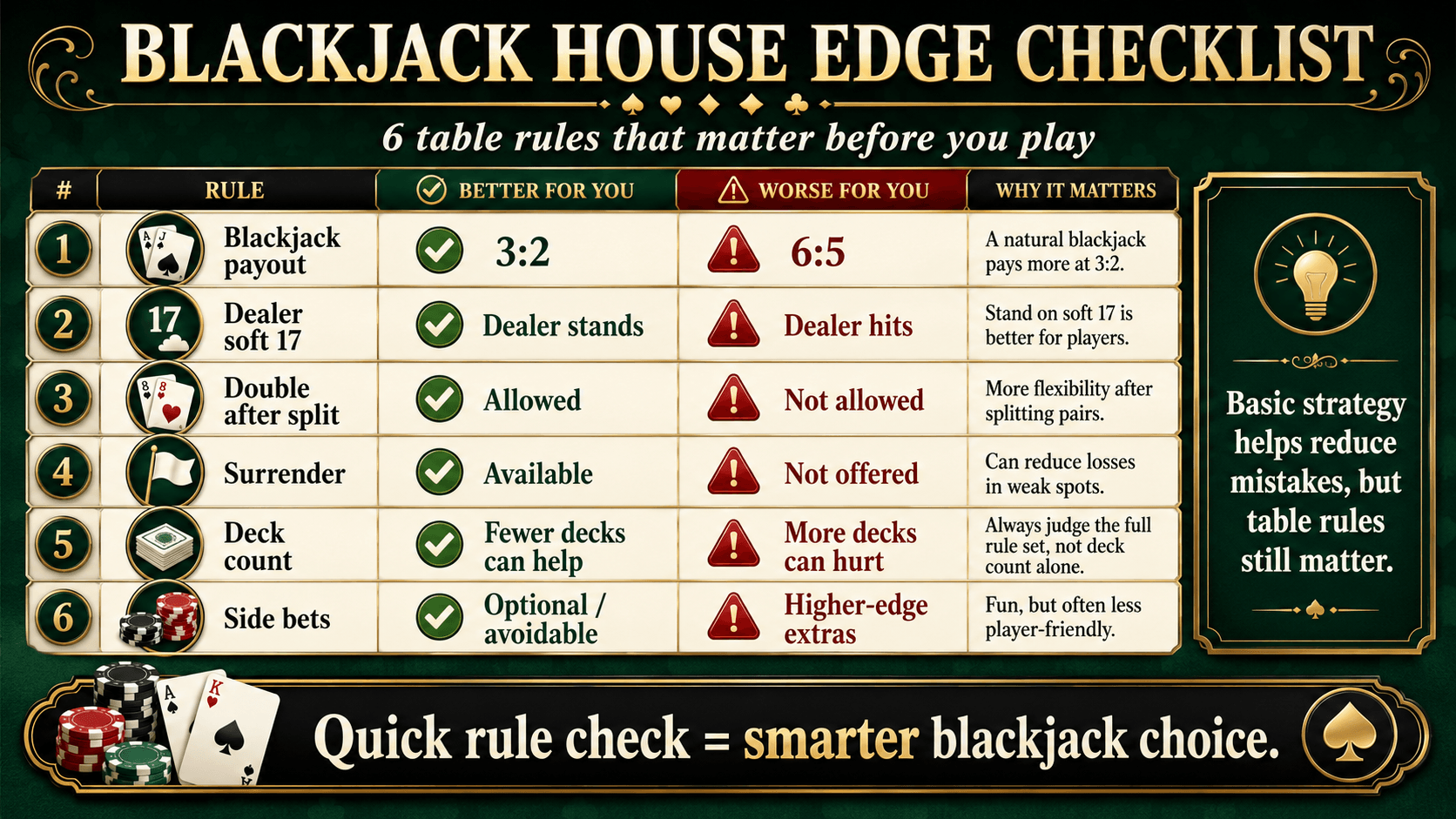
blackjack house edge rules checklist for comparing blackjack odds
What Is Blackjack House Edge?
Blackjack house edge is the average mathematical advantage the casino has over the player across many hands. It is usually shown as a percentage of total money wagered.
For example, if a blackjack game has a low house edge, that does not mean you will lose that exact percentage in one session. You might win, lose, or push several hands in a row. The edge becomes more meaningful over time because blackjack results are shaped by repeated decisions and repeated wagers.
Blackjack is different from many casino games because your choices matter. You decide when to hit, stand, double, split, or surrender. That means the blackjack house edge depends on both the rules of the game and the quality of your decisions.
Term | Simple Meaning | Why It Matters |
Blackjack house edge | The casino’s long-term advantage | Lower is better for players |
Blackjack odds | Your chance of winning, losing, or pushing | Helps compare rule sets |
Natural blackjack | Ace plus a 10-value card | Payout rule matters a lot |
Basic strategy | Best mathematical decision guide | Helps reduce mistakes |
Push | Tie with the dealer | Your original bet is returned |
A strong blackjack table gives you fairer rules and more player flexibility. A weak table may look almost the same but quietly increase the house advantage through worse payouts or restrictions.
Why Blackjack House Edge Is Not Fixed
The blackjack house edge is not fixed because blackjack rules change from table to table. Two games may both be called blackjack, but they can offer very different long-term value.
One table may pay 3:2 for a natural blackjack, allow double after split, and have the dealer stand on soft 17. Another table may pay 6:5, restrict doubling, and require the dealer to hit soft 17. Those two games are not equally good for players.
This is why checking the table minimum is not enough. A lower minimum can be useful for bankroll control, but bad rules can cost more over time.
Rule Area | Better for Players | Worse for Players |
Blackjack payout | 3:02 | 6:05 |
Dealer soft 17 | Dealer stands | Dealer hits |
Double after split | Allowed | Not allowed |
Surrender | Available | Not available |
Doubling rules | Any two cards | Restricted hands only |
Side bets | Optional or avoidable | Overemphasized |
The main lesson is simple: do not judge a blackjack table only by how it looks. Read the rules first. The blackjack house edge is hidden in the details.
Why 3:2 Blackjack Is Better Than 6:5
The most important beginner rule is this: 3:2 blackjack is better than 6:5 blackjack.
A natural blackjack is an Ace plus a 10, Jack, Queen, or King as your first two cards. In a standard 3:2 blackjack game, a $10 natural blackjack pays $15. In a 6:5 blackjack game, the same $10 hand pays only $12.
That $3 difference may not sound huge at first, but it matters because natural blackjacks are one of the strongest hands in the game. Reducing the payout increases the blackjack house edge and gives the casino a much better long-term position.
3:2 vs 6:5 Blackjack Payout Example
Bet Size | 3:2 Blackjack Pays | 6:5 Blackjack Pays | Player Gets Less With 6:5 |
$5 | $7.50 | $6.00 | $1.50 less |
$10 | $15.00 | $12.00 | $3.00 less |
$25 | $37.50 | $30.00 | $7.50 less |
$50 | $75.00 | $60.00 | $15.00 less |
$100 | $150.00 | $120.00 | $30.00 less |
The hand is exactly the same. The cards are exactly the same. The only difference is the rule printed on the table.
This is why many experienced players avoid 6:5 blackjack when a 3:2 blackjack table is available. A lower table minimum does not always make a game better if the payout rule is weaker.
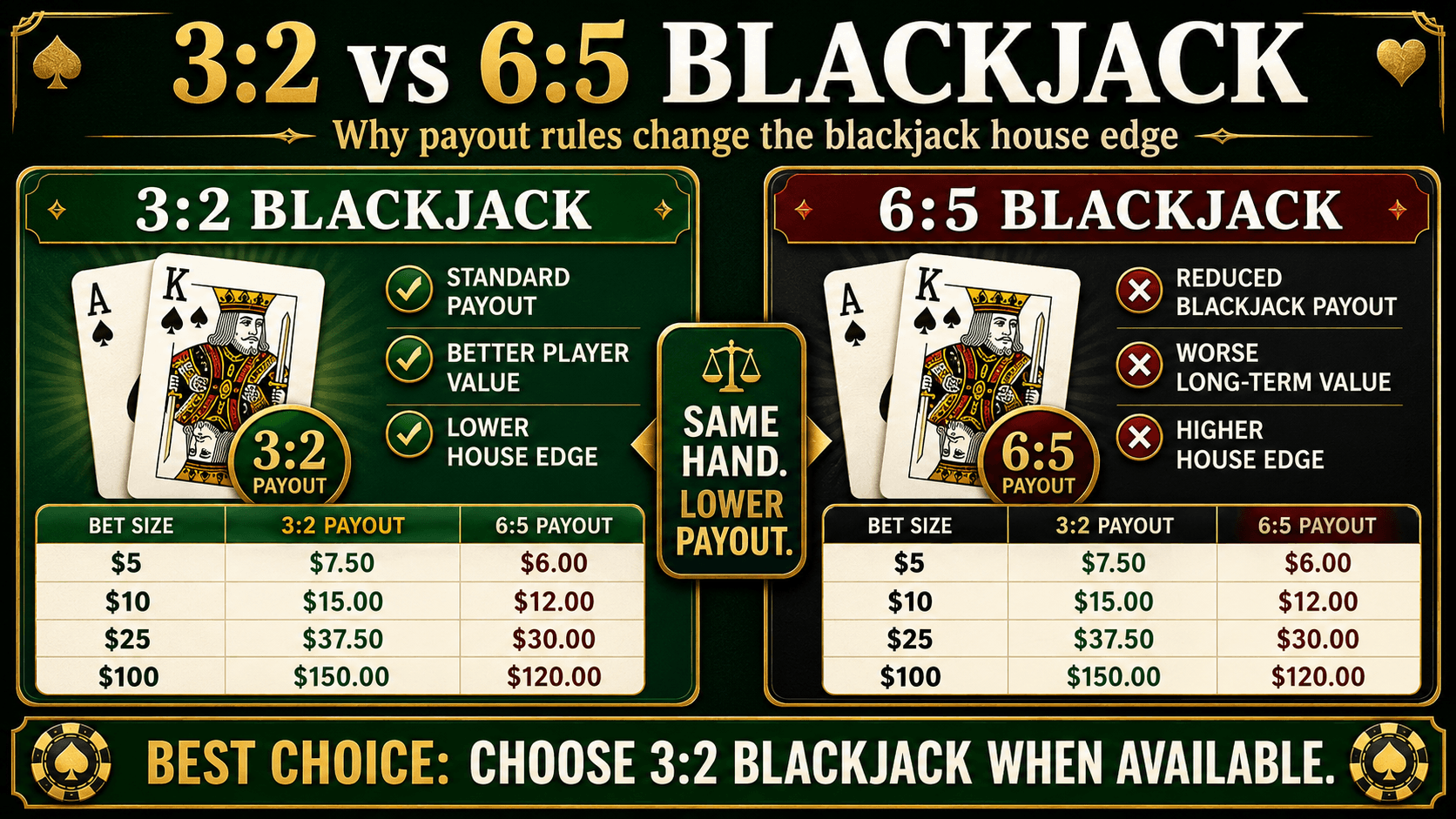
blackjack house edge comparison showing 3:2 blackjack vs 6:5 blackjack payouts
How Dealer Soft 17 Rules Affect the Blackjack House Edge
Dealer soft 17 is another rule that can change the blackjack house edge. A soft 17 is a dealer hand that totals 17 with an Ace counted as 11. The most common example is Ace-6.
Some blackjack tables require the dealer to stand on soft 17. Other tables require the dealer to hit soft 17. The second version is usually worse for players because the dealer gets another chance to improve the hand.
Dealer Rule | What It Means | Player Impact |
Dealer stands on soft 17 | Dealer stops with Ace-6 | Better for players |
Dealer hits soft 17 | Dealer draws another card with Ace-6 | Better for the casino |
This rule can feel small because it only affects certain hands. But blackjack is a game of repeated edges. A rule that improves the dealer’s options can shift long-term value away from the player.
When reading a table layout, look for wording such as “Dealer stands on all 17s” or “Dealer must hit soft 17.” If both options are available, the stand-on-soft-17 table is usually the better choice.
Double, Split, and Surrender Rules That Matter
Blackjack is a decision-based game, so player options are valuable. The more useful decisions you are allowed to make, the better your chances of reducing the blackjack house edge through correct play.
Double, split, and surrender rules can make a noticeable difference. These rules do not guarantee wins, but they let you handle strong or weak situations more efficiently.
Double After Split
Double after split means you can split a pair and then double down if the next card creates a strong hand. This is helpful because some split hands become excellent doubling opportunities.
For example, if you split a pair and then draw a strong total against a weak dealer upcard, doubling can give you more value. If the table blocks double after split, your options are more limited.
Surrender
Surrender lets you give up the hand and lose only half your bet in certain bad situations. It is not available at every table, but when used correctly, it can help reduce losses on very weak hands.
Late surrender is the common version many players look for. It gives you a way out after the dealer checks for blackjack.
Re-Splitting Pairs
Some tables allow you to split pairs more than once. Others limit re-splitting or restrict what you can do after splitting Aces.
More flexible split rules are generally better for the player because they allow stronger decision-making.
Rule | Better Version | Why It Helps |
Double after split | Allowed | Adds value after splitting |
Surrender | Available | Reduces damage on weak hands |
Re-splitting pairs | Allowed | Gives more flexibility |
Doubling | Any two cards | Better than restricted doubling |
Split Aces | Flexible rules | Helps with powerful starting cards |
These rules are easy to overlook, especially online where players may click into a game quickly. Before playing, open the rules screen and check how the table handles doubles, splits, surrender, and dealer actions.
Deck Count and Blackjack Odds
Deck count also affects blackjack odds, but it should not be judged alone. Blackjack may be played with one deck, two decks, six decks, or eight decks.
In general, fewer decks can be more favorable for players. However, a single-deck game with poor rules can still be worse than a multi-deck game with strong rules. The best example is single-deck 6:5 blackjack, which can look attractive but pays less on natural blackjack.
Game Type | Possible Benefit | What to Check First |
Single-deck blackjack | Fewer decks can help odds | Watch for 6:5 payouts |
Double-deck blackjack | Often attractive with good rules | Check soft 17 and doubling |
Six-deck blackjack | Common in casinos | Look for 3:2 payout |
Eight-deck blackjack | Common online and live dealer | Compare full rule set |
Deck count is part of the bigger picture. The better question is not “How many decks are used?” but “What is the full rule package?”
A six-deck 3:2 blackjack table with solid player rules can be a better choice than a single-deck table with 6:5 payouts and tight restrictions.
For players who want to understand the math behind chance, randomness, and expected results, this overview of probability theory provides useful background.
Blackjack Basic Strategy and Player Decisions
Blackjack basic strategy is a decision chart that tells you the mathematically preferred move based on your hand and the dealer’s upcard. It covers when to hit, stand, double, split, or surrender.
Basic strategy does not guarantee that you will win. It also does not remove the blackjack house edge. What it does is help you avoid unnecessary mistakes.
Many blackjack decisions feel uncomfortable. For example, hitting a stiff hand against a strong dealer card may feel risky, while standing may feel safer. Basic strategy focuses on the long-term result, not the emotional comfort of one hand.
Decision Type | How Basic Strategy Helps |
Hit or stand | Reduces guessing |
Double down | Finds strong value spots |
Split pairs | Avoids weak pair decisions |
Surrender | Limits losses in bad spots |
Insurance | Helps avoid poor-value side choices |
The biggest benefit of blackjack basic strategy is consistency. Instead of reacting to fear, frustration, or streaks, you make decisions based on the best available math.
If you are new to blackjack, start with a simple basic strategy chart for the rule set you are playing. The correct chart can change slightly depending on deck count and dealer soft 17 rules.
Blackjack Rules to Check Before Playing
The best blackjack decision often happens before you place your first bet. If you know what to check, you can avoid many bad tables quickly.
Start with the blackjack payout. If the table pays 3:2, keep reading the rules. If it pays 6:5, think carefully before playing, especially if a 3:2 option is available nearby.
Next, check the dealer soft 17 rule, double after split, surrender, deck count, and side bets. Side bets can be fun, but they often carry a higher house edge than the main blackjack game.
Rule to Check | Better Choice | Why It Matters |
Blackjack payout | 3:02 | Better natural blackjack payout |
Dealer soft 17 | Dealer stands | Lower casino advantage |
Double after split | Allowed | More player flexibility |
Surrender | Available | Helps reduce losses |
Deck count | Favorable with good rules | Must be judged with full rules |
Side bets | Optional or avoided | Often higher house edge |
If you compare blackjack tables online, also check game rules, bonus eligibility, wagering requirements, and state availability. Promotion terms can vary, and some bonuses may limit which games contribute toward wagering.
Before choosing where to play, compare safer site options in our guide to the Best Legit Social Casinos 2026. If you plan to claim a promotion, review the terms carefully and read our guide to Low Wagering Casino Bonuses 2026 to understand how bonus value can change in real play.
Common Mistakes That Increase the Blackjack House Edge
Many blackjack mistakes come from focusing on the wrong thing. Players often look at the table minimum, the seat location, or recent dealer streaks while ignoring the rules that actually affect the blackjack house edge.
One common mistake is choosing 6:5 blackjack because it has a lower minimum bet. A smaller minimum can help your budget, but the worse payout can hurt long-term value.
Another mistake is ignoring basic strategy. Playing by instinct may feel more natural, but blackjack rewards correct decisions over time.
Mistake | Why It Hurts |
Choosing 6:5 blackjack | Reduces natural blackjack payout |
Ignoring dealer soft 17 | Accepts worse rules without noticing |
Taking insurance too often | Usually poor value for basic strategy players |
Splitting 10s | Breaks up a strong hand |
Refusing strong doubles | Misses valuable opportunities |
Overusing side bets | Adds higher-edge wagers |
Chasing losses | Turns bad sessions into worse ones |
Side bets deserve special attention. They can make blackjack more exciting, but they are separate wagers with their own odds. A table can have good main-game rules while still offering side bets that are much less player-friendly.
Good blackjack play is not about predicting the next card. It is about choosing better rules, making better decisions, and avoiding avoidable cost.
3:2 vs 6:5 Blackjack Comparison Table
The 3:2 vs 6:5 rule is important enough to compare directly. It is one of the fastest ways to judge whether a blackjack table deserves your attention.
Feature | 3:2 Blackjack | 6:5 Blackjack |
$10 natural blackjack pays | $15 | $12 |
Player value | Better | Worse |
Effect on house edge | Lower | Higher |
Beginner recommendation | Prefer this version | Avoid when possible |
Common table feature | May have higher minimums | May advertise lower minimums |
Best use case | Standard blackjack play | Casual play only if accepted knowingly |
A 6:5 table can still produce winning sessions. You can still get lucky. But the rule gives you less money for one of the best hands in blackjack, and that matters over many hands.
If you only remember one rule from this guide, remember this: choose 3:2 blackjack when available.
Practical Tips for Choosing a Better Blackjack Table
Choosing a better blackjack table does not require advanced math. Start with the visible rules and make a few practical checks.
First, look for 3:2 blackjack. Second, prefer dealer stand on soft 17. Third, check whether double after split is allowed. Fourth, use blackjack basic strategy instead of guessing.
Player Goal | Best Practical Choice |
Lower blackjack house edge | Choose 3:2 blackjack |
Better decision support | Use basic strategy |
More flexible play | Look for double after split |
Lower avoidable loss | Use surrender correctly |
Better bankroll control | Choose sensible bet sizes |
Less extra risk | Be careful with side bets |
You should also set a session budget before playing. Blackjack can move quickly, especially online or in live dealer formats. A good table rule does not protect you from overbetting or chasing losses.
For safer play habits, visit our Responsible Gambling guide. If gambling stops feeling fun or controlled, independent support is also available through responsible gambling resources from the National Council on Problem Gambling.
Final Takeaway
The blackjack house edge depends on the rules and your decisions. That is what makes blackjack different from many casino games. You are not just picking a seat; you are choosing a rule set.
The most important rule is the natural blackjack payout. A 3:2 blackjack table gives you better value than a 6:5 blackjack table. Dealer soft 17, double after split, surrender, deck count, and side bets also affect the overall player experience.
Blackjack basic strategy helps you avoid costly decisions, but it does not guarantee profit. The goal is not to beat the game with guesses or streaks. The goal is to choose better rules, play consistently, and manage your bankroll.
The smartest move often happens before the first card is dealt: read the rules, avoid 6:5 when 3:2 is available, and treat blackjack as entertainment rather than income.