

Quick Summary: Roulette House Edge Explained
Roulette house edge is the built-in advantage the casino has on every roulette spin. It does not mean you will lose every time you play, but it does explain why the game favors the casino over the long run.
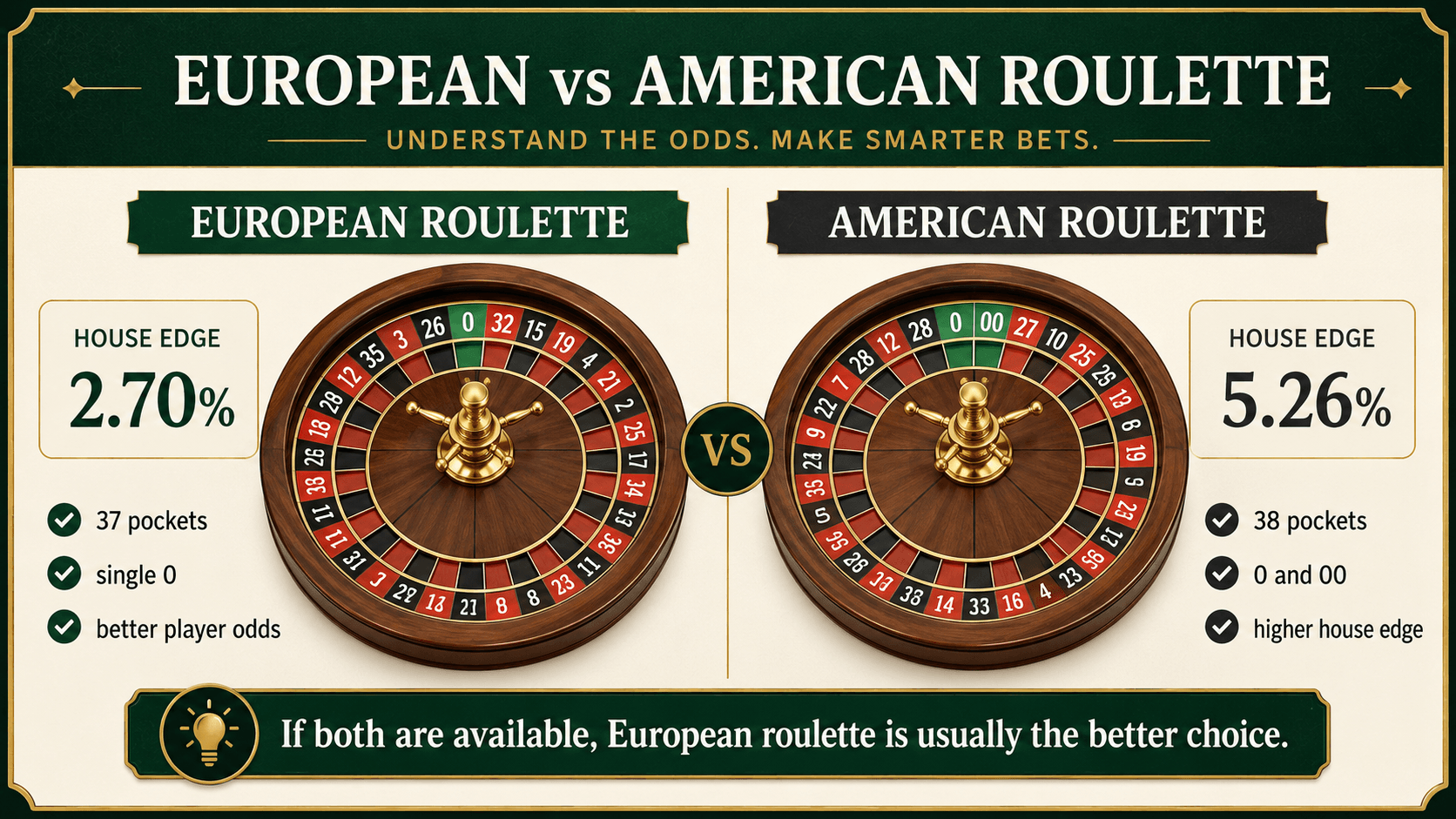
The biggest difference is simple: European roulette has one zero and a 2.70% house edge, while American roulette has 0 and 00, creating a 5.26% house edge. That extra double zero makes American roulette much less favorable for players.
If you are choosing between the two, European roulette is usually the smarter option. No betting system can remove the roulette house edge, but choosing the version with better odds can help your bankroll last longer and make your play more efficient.
This guide explains what the roulette house edge means, how European and American roulette compare, why zero pockets matter, and what practical choices you can make before placing your next bet.
roulette house edge comparison between European and American roulette
Freebetspin explains casino game concepts with a player-first editorial process. You can learn more about how we review gambling content in our Editorial Guidelines and Review Methodology
What Is the House Edge in Roulette?
The house edge in roulette is the casino’s average mathematical advantage over the player. In simple terms, it is the gap between the true odds of an outcome and the payout the casino gives you when that outcome wins.
For example, a roulette bet may feel close to fair because the wheel has many possible outcomes and the payouts look simple. But the green zero pockets are what tilt the game toward the casino.
A roulette house edge does not tell you what will happen in one spin or one short session. You can win quickly, lose quickly, or swing up and down. The house edge becomes more meaningful over many spins because it applies to the total amount wagered over time.
Term | Simple Meaning | Why It Matters |
House edge | The casino’s built-in advantage | Lower is better for players |
Roulette odds | The chance of a bet winning | Helps you understand risk |
Payout | What you win if your bet hits | May not fully match true odds |
Variance | Short-term ups and downs | Explains why results can swing |
Bankroll | Your playing budget | Helps control session risk |
Think of the roulette house edge like a small leak in a bucket. One drop may not matter much, but over time, the leak becomes noticeable. That is why game selection matters, especially if you play roulette often.
Why the Roulette House Edge Matters
The roulette house edge matters because it affects how much value you give up over time. A game with a lower edge gives you a better chance to stretch your bankroll, enjoy more spins, and reduce long-term expected loss.
This does not mean lower-edge roulette guarantees profit. Roulette is still a casino game with random outcomes. But if two games play almost the same and one gives the casino a smaller advantage, that version is usually the better choice.
Here is the simplest player comparison:
Player Choice | House Edge | Player-Friendly Rating | Best For |
European roulette | 2.70% | Stronger | Players who want better roulette odds |
American roulette | 5.26% | Weaker | Casual players who prefer the American layout |
Betting systems | Does not change the edge | Limited value | Players who want structure, not better odds |
Smaller bet sizes | Does not change the edge | Useful for control | Players managing a fixed budget |
Imagine two players each betting $10 per spin. One plays European roulette, and the other plays American roulette. In a short session, either player could win. But over a long period, the American roulette player is facing almost double the casino advantage.
That is why understanding the roulette house edge is more useful than chasing lucky numbers, hot streaks, or complicated betting patterns.
European Roulette House Edge
The European roulette house edge is 2.70% in standard European roulette. This version has 37 pockets: numbers 1–36 plus a single green 0.
Because there is only one zero, European roulette gives players better odds than American roulette. The gameplay still feels the same for most beginners. You can bet on numbers, colors, odds, evens, dozens, columns, or sections of the table. The key difference is that the wheel is slightly more favorable.
Feature | European Roulette |
Total pockets | 37 |
Zero pockets | One: 0 |
Standard house edge | 2.70% |
Common outside bets | Red/black, odd/even, high/low |
Best for | Players who want a lower roulette house edge |
The European roulette house edge applies across most standard bets because the payout table is built around the single-zero wheel. Whether you bet on red, a dozen, or one straight-up number, the casino still keeps the same average advantage in most standard versions.
If you want to compare sites that offer casino-style games and social casino options, start with our guide to the Best Legit Social Casinos 2026 before choosing where to play.
Why European Roulette Is Better for Most Players
European roulette is usually better because the game gives the casino less help. There is only one green zero that can make common outside bets lose.
For example, a red/black bet may look like a 50-50 chance, but it is not exactly even. There are 18 red numbers and 18 black numbers, plus one green zero. If the ball lands on zero, red and black both lose.
That single zero is enough to create the 2.70% roulette house edge. Still, compared with American roulette, European roulette is the more player-friendly version.
American Roulette House Edge
The American roulette house edge is 5.26% in standard American roulette. This version has 38 pockets: numbers 1–36, one green 0, and one green 00.
That extra 00 is the entire reason American roulette is less favorable. The payouts are usually the same as European roulette, but the wheel has one more losing outcome for many common bets.
Feature | American Roulette |
Total pockets | 38 |
Zero pockets | Two: 0 and 00 |
Standard house edge | 5.26% |
Common outside bets | Red/black, odd/even, high/low |
Main drawback | Higher roulette house edge |
American roulette is still popular, especially in many U.S. casino environments. Some players also enjoy the familiar layout or simply play the version available at their casino.
But from a pure odds perspective, American roulette is a weaker choice. If European roulette and American roulette are both available, the lower-edge European wheel is usually the better pick.
Why 0 and 00 Matter So Much
The zero pockets are the heart of the roulette house edge. Without them, many roulette bets would be much closer to fair. With them, the casino has a built-in advantage.
Let’s use a red/black bet as an example. On both European and American wheels, there are 18 red numbers and 18 black numbers. The difference is the green pocket count.
Bet Example | European Roulette | American Roulette | Standard Payout |
Red or black | 18 winning pockets out of 37 | 18 winning pockets out of 38 | 1:01 |
Odd or even | 18 winning pockets out of 37 | 18 winning pockets out of 38 | 1:01 |
High or low | 18 winning pockets out of 37 | 18 winning pockets out of 38 | 1:01 |
Single number | 1 winning pocket out of 37 | 1 winning pocket out of 38 | 11:01 |
Dozen bet | 12 winning pockets out of 37 | 12 winning pockets out of 38 | 2:01 |
The payout does not fully compensate for the zero pockets. That is where the roulette house edge comes from.
In European roulette, the single 0 creates a smaller casino advantage. In American roulette, both 0 and 00 create more losing outcomes while the standard payouts stay the same.
This is why a small-looking wheel difference can have a major effect on long-term roulette odds.
roulette house edge guide showing common roulette bets and payouts
Common Roulette Bets and Payouts
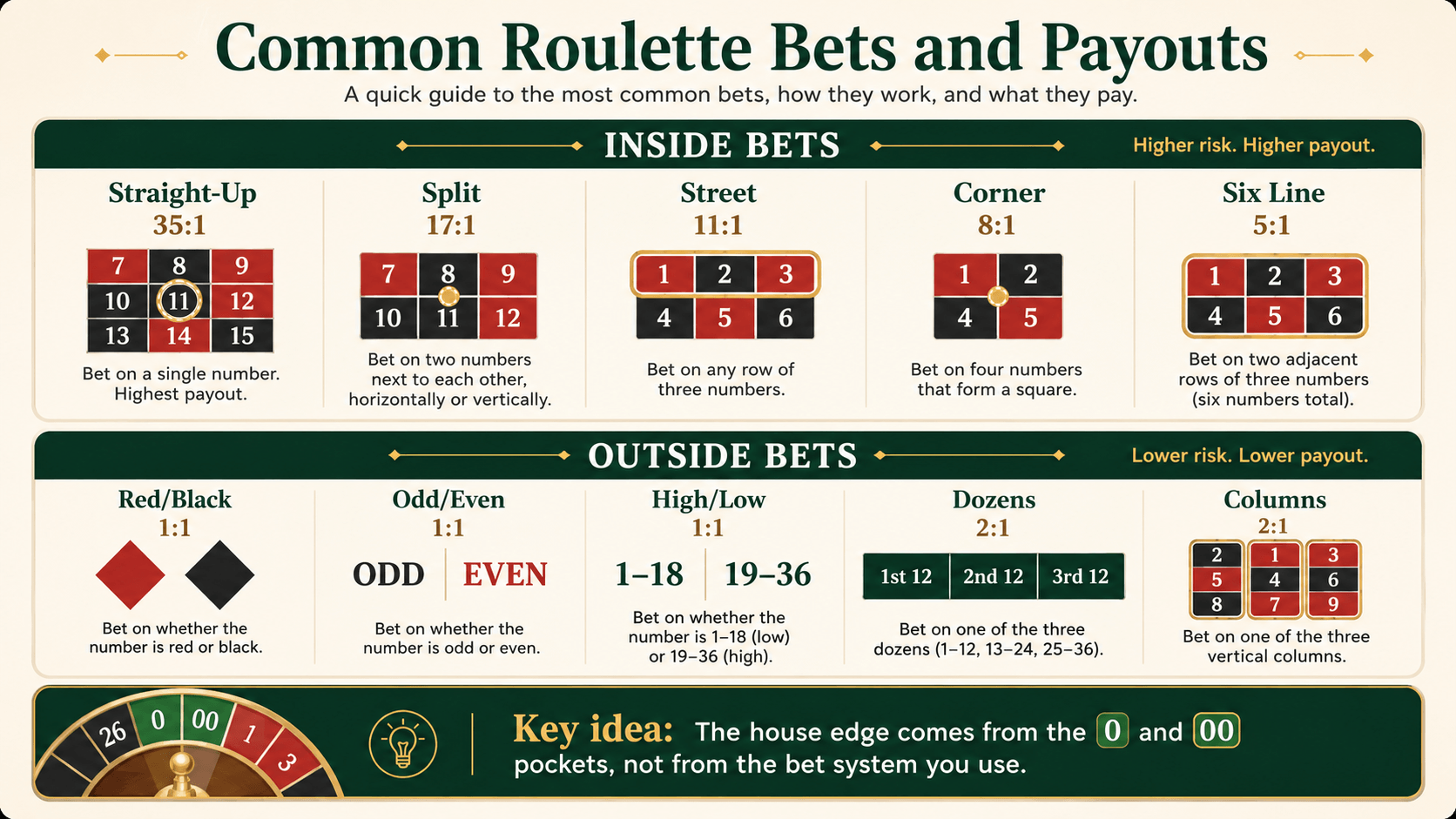
Roulette bets usually fall into two groups: inside bets and outside bets. Inside bets focus on specific numbers or small number groups. Outside bets cover larger sections of the table, such as colors, dozens, or odd/even outcomes.
Many beginners think bigger payouts mean better bets. That is not usually true. A straight-up number pays much more than red or black, but it also wins far less often. In standard roulette, most common bets within the same game version carry the same roulette house edge.
Inside Roulette Bets
Inside bets are placed on the numbered area of the table. They have lower hit frequency but higher payouts.
Inside Bet | What You Cover | Standard Payout | Player Experience |
Straight-up | One number | 11:01 | Rare hit, biggest standard payout |
Split | Two numbers | 17:01 | Covers two neighboring numbers |
Street | Three numbers | 11:01 | Covers one horizontal row |
Corner | Four numbers | 8:01 | Covers a block of four numbers |
Six line | Six numbers | 5:01 | Covers two rows |
Inside bets can be exciting because a single win can feel big compared with your stake. But they also bring longer losing stretches because they cover fewer numbers.
Outside Roulette Bets
Outside bets cover larger groups of numbers. They hit more often but pay less.
Outside Bet | What You Cover | Standard Payout | Beginner Note |
Red/black | One color | 1:01 | Simple and easy to follow |
Odd/even | Odd or even numbers | 1:01 | Zero pockets still lose |
High/low | 1–18 or 19–36 | 1:01 | Popular for steady play |
Dozens | 12-number section | 2:01 | Medium hit frequency |
Columns | One table column | 2:01 | Covers 12 numbers |
Outside bets are often easier for beginners because they win more frequently than inside bets. But they do not remove the roulette house edge. They simply change the rhythm of your wins and losses.
How Roulette House Edge Works in Real Gameplay
The roulette house edge applies to your total amount wagered, not just your starting balance. This is an important point because casino games move quickly.
For example, if you start with $100 and make 100 bets of $5, your total wagering action is $500. The house edge applies to that $500 in long-term mathematical terms.
Scenario | Game Type | Total Wagered | House Edge | Long-Term Expected Casino Edge |
100 spins at $5 | European roulette | $500 | 2.70% | $13.50 |
100 spins at $5 | American roulette | $500 | 5.26% | $26.30 |
100 spins at $10 | European roulette | $1,000 | 2.70% | $27.00 |
100 spins at $10 | American roulette | $1,000 | 5.26% | $52.60 |
These numbers are not a prediction for one session. You could win on your first spin, hit a lucky streak, or lose faster than expected. The point is that the roulette house edge shows the average long-term cost of playing a specific version of the game.
A higher bet size does not change the percentage edge, but it does increase the dollar impact. A faster game also increases the number of spins you play, which increases your total wagering volume.
That is why smart roulette play is not only about picking numbers. It is also about choosing the right roulette version, setting a budget, and understanding how many bets you are making.
Can Roulette Strategies Reduce the House Edge?
Roulette strategies can organize how you bet, but they cannot remove the roulette house edge. This is one of the most important things for new players to understand.
Every roulette spin is independent. For a broader explanation of how probability works in random events, Britannica’s guide to probability theory is a useful neutral reference. The wheel does not remember previous results. If black has landed five times in a row, red is not “due” in a way that changes the next spin’s actual odds.
Many betting systems are based on changing stake size after wins or losses. They may make your play feel more structured, but they do not change the wheel, the zero pockets, or the payout table.
Roulette Strategy | How It Works | Does It Reduce the House Edge? | Main Risk |
Martingale | Doubles after each loss | No | Bet sizes can grow quickly |
Fibonacci | Uses a number sequence | No | Long losing streaks can be costly |
D’Alembert | Raises or lowers bets gradually | No | Still depends on random outcomes |
Flat betting | Uses the same stake each spin | No | Does not create an advantage |
Choosing European roulette | Selects the lower-edge wheel | Yes, compared with American roulette | Still a casino-favored game |
Why Martingale Does Not Beat Roulette
The Martingale system is popular because it sounds simple. You double your bet after each loss, hoping one win will recover previous losses and add a small profit.
The problem is that losing streaks happen. Your required bet size can rise quickly, and table limits can stop you before the system completes. Even if you win several small sessions, one bad streak can erase many previous gains.
A roulette strategy can help you stay disciplined, but it should not be treated as a way to beat the math. The better practical move is to play the lower-edge version and manage your bankroll carefully.
For more general probability background, you can read this plain-language explanation of probability theory.
European vs American Roulette: Which Should You Choose?
If both versions are available, most players should choose European roulette. The reason is clear: the European roulette house edge is 2.70%, while the American roulette house edge is 5.26%.
The games look similar. The betting options are mostly familiar. The table experience is easy to understand in both versions. But the long-term cost is different.
Player Goal | Better Choice | Why |
Lower roulette house edge | European roulette | One zero instead of 0 and 00 |
Longer bankroll life | European roulette | Lower expected loss over time |
Simple beginner play | European roulette | Same easy format, better odds |
U.S.-style casino layout | American roulette | Familiar in many American casinos |
Casual entertainment | Either, but European is better | Same core game, different edge |
Strategy testing | European roulette | Lower edge gives a cleaner comparison |
American roulette is not “wrong” to play if you enjoy it casually. But if your goal is to make the most player-friendly choice, European roulette is the stronger option.
Before choosing an online casino, compare game libraries, roulette versions, payment options, and bonus rules through our online casino reviews. If you plan to claim a promotion, also check our casino bonus guide so you understand wagering rules, eligible games, expiry dates, and withdrawal terms.
Practical Tips for Playing Roulette Smarter
You do not need a complicated system to make better roulette decisions. A few simple habits can help you understand the game and avoid common mistakes.
First, choose European roulette when possible. This is the easiest way to lower the casino advantage without changing how you play.
Second, set a session budget before you start. Before playing any casino-style game, set limits and understand the risks. Our Responsible Gambling guide explains practical ways to keep gambling entertainment-focused. Roulette can move quickly, especially online, so it is easy to place more bets than you planned.
Third, keep your bet size reasonable. Smaller bets do not change the roulette house edge, but they can help your bankroll last longer.
Smart Roulette Habit | Why It Helps |
Choose European roulette | Gives you a lower house edge |
Set a fixed budget | Keeps play controlled |
Use smaller stakes | Helps extend your session |
Avoid chasing losses | Reduces emotional betting |
Check table limits | Prevents strategy problems |
Learn the payout table | Helps you understand risk |
Treat roulette as entertainment | Keeps expectations realistic |
It also helps to read the rules of any roulette game before you play. Online casinos may offer European, American, French, live dealer, or special roulette variants. Some versions include extra side bets or bonus features, and those may come with different odds.
If you want to compare roulette with other casino games, visit our casino game guides for more beginner-friendly explainers.
Responsible play also matters. If gambling stops feeling fun or you find it hard to stay within your limits, use independent support resources such as the National Council on Problem Gambling’s responsible gambling resources.
Final Takeaway
The roulette house edge is the key number that tells you how much advantage the casino has over time. Once you understand it, the European vs American roulette choice becomes much easier.
European roulette has a 2.70% house edge because it has one zero. American roulette has a 5.26% house edge because it has both 0 and 00. That extra pocket nearly doubles the casino’s advantage.
No roulette strategy can change the math of the wheel. Systems like Martingale or Fibonacci may change how you size your bets, but they do not change the odds.
If you remember one thing, make it this: choose European roulette when available. It will not guarantee wins, but it gives you a lower roulette house edge and a better long-term playing position than American roulette.