

Quick Summary: What is AI Soccer Predictions ?
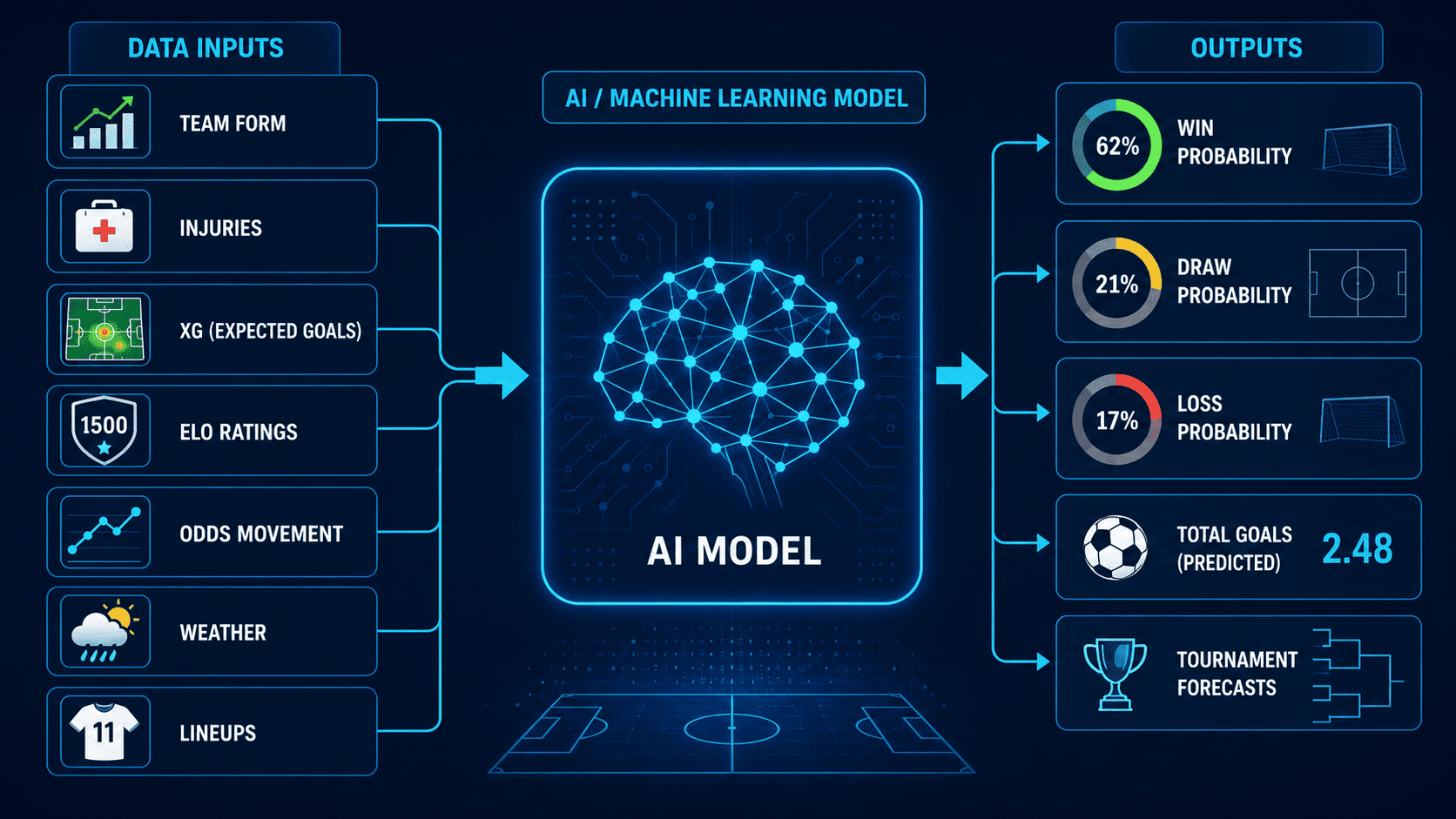
AI soccer predictions use data to estimate what may happen in a soccer match. A model might look at team form, injuries, xG, Elo ratings, betting odds, travel, rest, lineups, and past results, then output probabilities for a win, draw, or loss.
For example, an AI model may say Team A has a 52% chance to win, the draw has a 24% chance, and Team B has a 24% chance. That does not mean Team A will definitely win. It means the model sees Team A as the more likely outcome based on the data it has.
That difference matters. AI soccer predictions are probability tools, not crystal balls. Soccer is low-scoring, emotional, tactical, and full of sudden events such as red cards, penalties, injuries, goalkeeper saves, and late goals.
AI soccer predictions explained with machine learning model odds and World Cup forecasts
Concept | Simple Meaning |
AI soccer predictions | Data-based probability estimates for soccer matches |
Machine learning | A model learns patterns from past match data |
Prediction output | Win, draw, loss, scoreline, totals, or probability |
Betting odds AI | Using odds movement as one signal in a model |
Main risk | Soccer results still include randomness |
Best use | Better understanding, not guaranteed outcomes |
What Are AI Soccer Predictions?
AI soccer predictions are forecasts created by computer models that analyze soccer data. The model looks for patterns in past matches and uses those patterns to estimate future outcomes.
A good AI model does not simply say, “Team A will win.” It should explain the chance of each outcome. In soccer, that usually means win, draw, and loss probabilities.
Prediction Type | What It Tries to Estimate |
Match winner | Win, draw, or loss probability |
Scoreline | Possible final score |
Total goals | Over / under goal expectation |
Both teams to score | Chance both teams score |
Tournament forecast | Team advancement or title probability |
Player props | Player shots, goals, assists, or cards |
Think of AI as a very fast analyst. It can process more data than a human can manually review. But it still depends on the quality of the data and the logic of the model.
That is why AI soccer predictions should be treated as support for your thinking, not as final answers.
How Machine Learning Predicts Soccer Matches
Machine learning sounds technical, but the basic process is easy to understand. A model studies past matches, learns which signals tend to matter, and then applies those lessons to future games.
A simple soccer prediction model might learn that strong attacking numbers, good defensive ratings, shorter betting odds, and better rest can increase a team’s chance of winning. It may also learn that draws are common when teams are evenly matched.
Step | Plain-English Explanation |
Data collection | Gather past matches, teams, goals, ratings, odds, and player information |
Feature building | Turn raw data into useful signals |
Training | Let the model learn patterns from past matches |
Testing | Check how it performs on matches it has not seen |
Prediction | Output probabilities for new matches |
Review | Compare predictions with results and improve the model |
Recent machine learning work on soccer match prediction often discusses the challenge of testing models fairly because datasets, features, and evaluation methods can differ. A published Springer article on evaluating soccer prediction models notes that machine learning models are increasingly popular, but model evaluation is difficult when public benchmark datasets are limited. You can read more in this soccer match prediction model evaluation study.
For readers, the takeaway is simple: a model is only as useful as its data, testing, and explanation.
What Data Goes Into an AI Soccer Prediction Model?
AI soccer predictions can use many types of data. Some models use only basic match results. Better models may include team ratings, odds, xG, squad news, injuries, rest, travel, weather, and lineups.
The exact inputs depend on the model. More data is not always better. Clean, relevant data usually matters more than dumping everything into the algorithm.
Data Input | Why It Matters |
Recent form | Shows current results and momentum |
Elo ratings | Measures opponent-adjusted team strength |
FIFA rankings | Adds official international context |
xG / expected goals | Measures chance quality |
Goals scored / conceded | Shows basic attacking and defensive output |
Injuries and suspensions | Changes lineup quality |
Starting lineups | Affects team strength on matchday |
Rest and travel | Important during tournaments |
Weather | Can affect tempo and scoring |
Betting odds movement | Reflects market expectation and news |
Head-to-head history | Sometimes useful, but easy to overrate |
Tactical style | Helps explain matchups |
Expected goals can be especially useful because it measures chance quality, not just final score. Hudl / StatsBomb explains xG as a metric that estimates the probability of a shot becoming a goal on a 0 to 1 scale. You can learn more in this expected goals explanation.
For a beginner-friendly betting version, Freebetspin’s xG soccer betting guide explains how chance quality connects to match odds and World Cup predictions.
Common AI Models Used in Soccer Forecasts
You do not need to code a model to understand how AI soccer predictions work. It helps to know the basic model types, but the important question is always the same: does the model produce useful probabilities?
Logistic Regression
Logistic regression is a basic probability model. It weighs signals such as team strength, recent form, and home advantage, then estimates the chance of each outcome.
It is popular because it is easier to explain. If a model says Team A is favored, you can often see which factors pushed the probability upward.
Random Forest
A random forest combines many small decision trees. Each tree asks simple questions, such as whether Team A has better recent form or stronger defensive numbers. The model then combines the results.
A friendly way to think about it: many small analysts vote, and the model averages their views.
Gradient Boosting
Gradient boosting builds models step by step. Each new step tries to improve on mistakes made by earlier steps.
This type of model can work well with structured sports data, but it still needs clean inputs and careful testing.
Neural Networks
Neural networks are flexible models that can learn complex patterns. They can be powerful when there is enough data, but more complexity does not automatically mean better soccer predictions.
A simple model with strong data can beat a complicated model with messy inputs.
Model Type | Simple Meaning | Best For | Main Limitation |
Logistic Regression | Basic probability model | Clear, explainable predictions | May miss complex patterns |
Random Forest | Many decision trees combined | Nonlinear patterns | Can be harder to interpret |
Gradient Boosting | Models improve step by step | Structured match data | Can overfit if poorly used |
Neural Network | Learns complex relationships | Large datasets | Needs strong data and careful testing |
The model name is less important than the prediction quality. A flashy football prediction algorithm is not useful if it hides its inputs, ignores uncertainty, or turns probabilities into fake certainty.
How AI Turns Data Into Win / Draw / Loss Probabilities
Most useful AI soccer predictions output probabilities. That is important because soccer has three common match outcomes: win, draw, and loss.
A model may produce a table like this:
Outcome | AI Model Probability | Plain-English Meaning |
Team A win | 52% | Team A is favored, not guaranteed |
Draw | 24% | The draw remains realistic |
Team B win | 24% | The underdog still has a chance |
This is where many fans misunderstand AI. If Team A has a 52% chance and loses, the model was not automatically “wrong.” A 52% probability still leaves 48% for other outcomes.
Good forecasts should make this clear. They should not present AI soccer predictions as guaranteed picks.
A better prediction says: “Team A is more likely, but the draw and Team B win are still meaningful possibilities.”
AI soccer predictions flowchart showing data inputs model training probabilities and match forecasts
How Betting Odds Help AI Read Market Expectations
Betting odds can be useful inputs for AI models because they reflect market expectations. Odds often react to team strength, injuries, public demand, lineup news, and tournament path.
If a team’s odds shorten, the market is becoming more confident in that team. If odds drift, confidence may be weakening. But odds are not pure truth. They include bookmaker margin and can also be affected by public betting behavior.
Odds Signal | What It May Tell the Model |
Shortening odds | Market confidence is increasing |
Drifting odds | Market confidence is weakening |
Sharp movement | New information may be entering |
Stable odds | Market view may be settled |
Popular teams | Price may include public demand |
Outright World Cup odds | Market-implied tournament strength |
This is why betting odds AI should be handled carefully. Odds are valuable, but a model should understand that they are prices, not perfect probabilities.
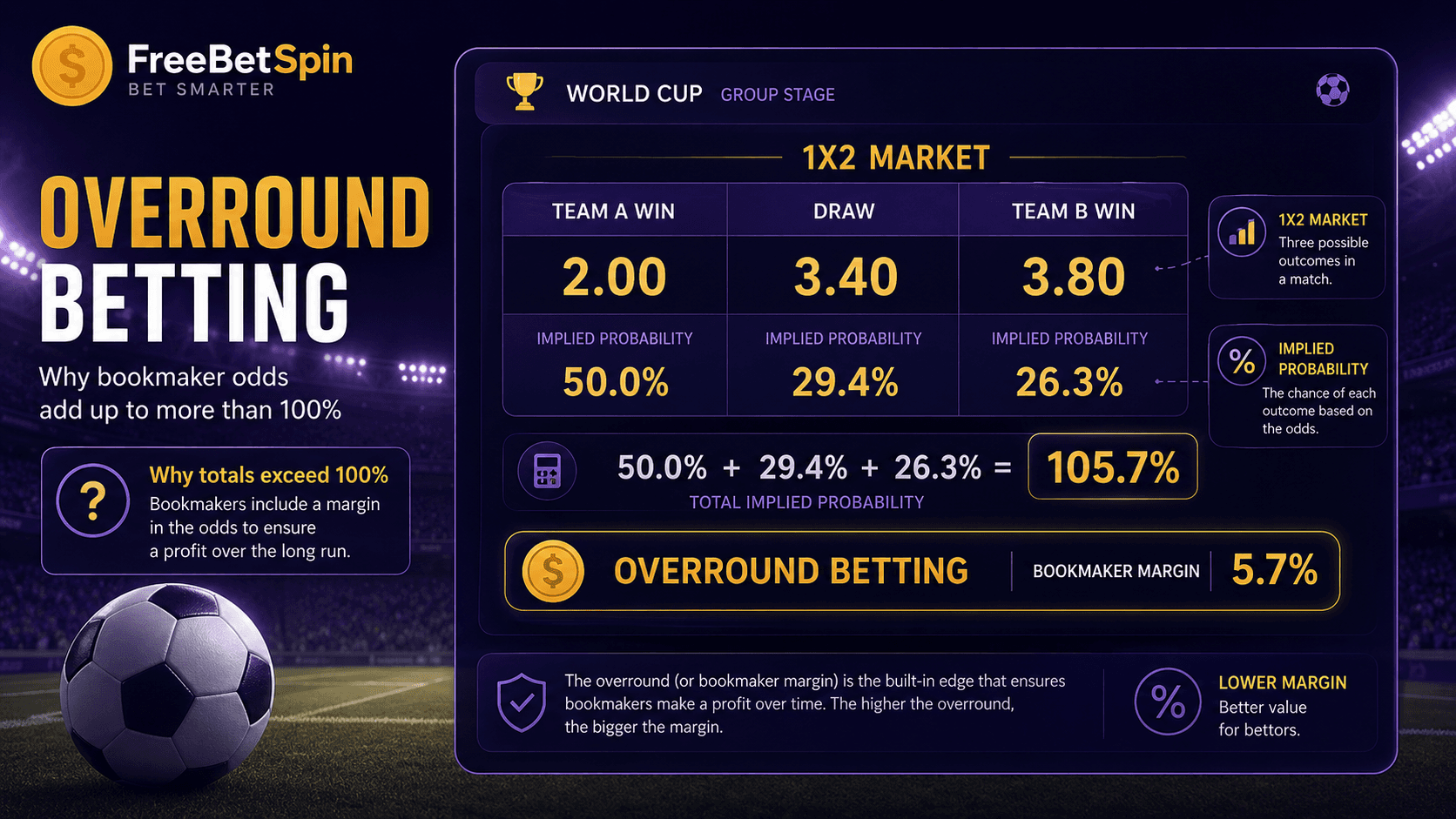
Freebetspin’s soccer betting odds explained guide explains how odds show payout and implied probability. For the margin inside those prices, read overround betting explained.
AI Soccer Predictions vs Human Experts
AI and human experts are good at different things. AI can process large datasets quickly. Human experts can understand tactical context, dressing-room news, motivation, and visual match patterns in ways that may be hard to encode.
The strongest approach often combines both.
Factor | AI Model | Human Expert |
Processes large datasets | Strong | Limited |
Understands tactical nuance | Limited unless encoded | Strong |
Avoids fan emotion | Usually strong | Depends on the person |
Explains reasoning naturally | Often weaker | Stronger |
Handles injury context | Only if data is included | Strong if informed |
Reacts to breaking news | Only if updated | Can react quickly |
Spots lineup surprises | Needs data feed | Can analyze context |
For example, an AI model may still rate a team highly because of season-long numbers. A human analyst may notice that two key midfielders are missing, the coach changed shape, and the replacement striker changes the attack.
On the other hand, a human fan may overreact to one famous player or one emotional match. AI can help reduce that bias.
Why AI Soccer Predictions Still Get Matches Wrong
AI soccer predictions fail for the same reason human predictions fail: soccer is unpredictable.
A match can change in one moment. A penalty, red card, deflection, goalkeeper mistake, or injury can destroy the cleanest model forecast.
Why AI Can Be Wrong | Simple Explanation |
Soccer is low-scoring | One goal changes everything |
Red cards | Models may not predict sudden events |
Penalties | One moment can swing the result |
Injuries | Late lineup changes matter |
Weather | Can change match tempo |
Goalkeeper performance | Saves can beat the model |
Small samples | International teams play fewer matches |
Tactical surprises | Coaches change plans |
Data quality | Poor inputs create poor outputs |
Market movement | Odds can change after model output |
This is especially true during the World Cup. International teams play fewer competitive matches than clubs, and tournament samples are short. One group-stage match can create a huge media reaction, but it may not be enough data to change a team’s true strength.
That is why uncertainty should always remain part of the forecast.
How AI Can Support World Cup Forecasts
AI can be useful for World Cup forecasts because the tournament creates many connected questions. Who is likely to win a group? Which teams have the easiest path? Which favorites may be overpriced? Which underdogs have stronger data than public attention suggests?
AI can help organize those questions.
Group Stage Forecasts
Group-stage models estimate win, draw, and loss probabilities for each match. From there, they can estimate qualification chances.
This is useful because a team does not need to win every match to advance. Draw probability and goal difference can matter.
Knockout Round Forecasts
Knockout forecasts are harder because extra time, penalties, injuries, and conservative tactics can increase uncertainty.
A model may simulate bracket paths, but it still cannot predict the exact chaos of knockout soccer.
Outright World Cup Predictions
Outright models may combine team strength, draw path, xG, Elo, odds, squad health, and match simulations to estimate title probability.
That does not mean the top model team will win. It means the model gives that team the strongest probability at that moment.
Underdog Detection
AI can also flag underdogs with stronger underlying numbers than casual fans expect. For example, a team may have modest public attention but strong defensive data, good xG difference, and a favorable group.
World Cup Use Case | How AI Helps |
Group stage | Estimates qualification chances |
Knockout stage | Simulates bracket paths |
Futures markets | Converts title paths into probabilities |
Match odds | Compares model view with market price |
Underdogs | Finds teams with strong data but less hype |
Injury impact | Adjusts team strength when lineup data is included |
For a wider tournament overview, Freebetspin’s World Cup predictions and betting guide covers odds, markets, predictions, bonus terms, and common betting mistakes.
What AI Predictions Mean for Bettors
AI can help bettors think in probabilities. That is useful because betting decisions should be about price, probability, and risk — not just team names.
If an AI model says Team A has a 55% chance to win, the next question is not “Should I bet Team A?” The better question is: what do the sportsbook odds imply?
AI Output | Better User Question |
Team A 55% | What odds imply this probability? |
Team B 18% | Is the longshot price actually fair? |
Draw 27% | Is the market underpricing draw risk? |
Over 2.5 goals 48% | Does the sportsbook price offer value? |
Title chance 12% | Is the outright price better than the model view? |
This does not turn AI into a betting system. It turns AI into a research tool.
Users should also check legal access before betting. State availability, age requirements, KYC, geolocation, and sportsbook rules can vary.
Practical Checklist Before Trusting an AI Pick
Before trusting any AI pick, slow down and ask how the prediction was created. A model that gives a confident “lock” without probabilities, inputs, or uncertainty is not giving you much to work with.
Before Trusting an AI Prediction | Check |
Does the model explain its inputs? | ☐ |
Does it show probabilities, not guaranteed picks? | ☐ |
Does it account for injuries and lineups? | ☐ |
Does it include recent form and opponent strength? | ☐ |
Does it compare against market odds? | ☐ |
Does it update before kickoff? | ☐ |
Does it mention uncertainty? | ☐ |
Are you using it as support, not certainty? | ☐ |
A useful AI prediction should help you understand the match better. It should not pressure you into betting.
Common Mistakes With AI Soccer Predictions
The biggest mistake is treating AI like a guaranteed answer. The second biggest mistake is ignoring price.
A model can correctly rate a team as more likely to win, while the sportsbook price is still too short to be attractive. That is why odds matter.
Mistake | Better Approach |
Treating AI picks as guaranteed | Read them as probabilities |
Ignoring odds | A good team pick can still be a bad price |
Trusting black-box claims | Look for inputs and logic |
Ignoring late lineup news | Models need updated information |
Chasing longshots | High odds are not automatically value |
Using AI without bankroll limits | Set betting limits first |
Ignoring legal access | Sports betting rules vary by state |
AI soccer predictions can make your analysis sharper, but they can also create false confidence if you forget uncertainty.
Conclusion: AI Can Improve Forecasts, But It Cannot Remove Soccer Uncertainty
AI soccer predictions are useful because they organize data, estimate probabilities, and help fans understand World Cup forecasts more clearly.
Machine learning models can process team form, xG, Elo ratings, odds movement, injuries, lineups, rest, travel, and match history. They can support smarter analysis and help explain why a team is favored or why a market may move.
But AI cannot guarantee results. Soccer is low-scoring, emotional, tactical, and full of random moments.
The right way to use AI is as one tool in your decision process. Combine it with odds, lineups, injuries, match context, legal access, and responsible gambling limits.
A strong forecast should make you more informed, not more reckless.