

Quick Answer: Online Casino Legality in the U.S.
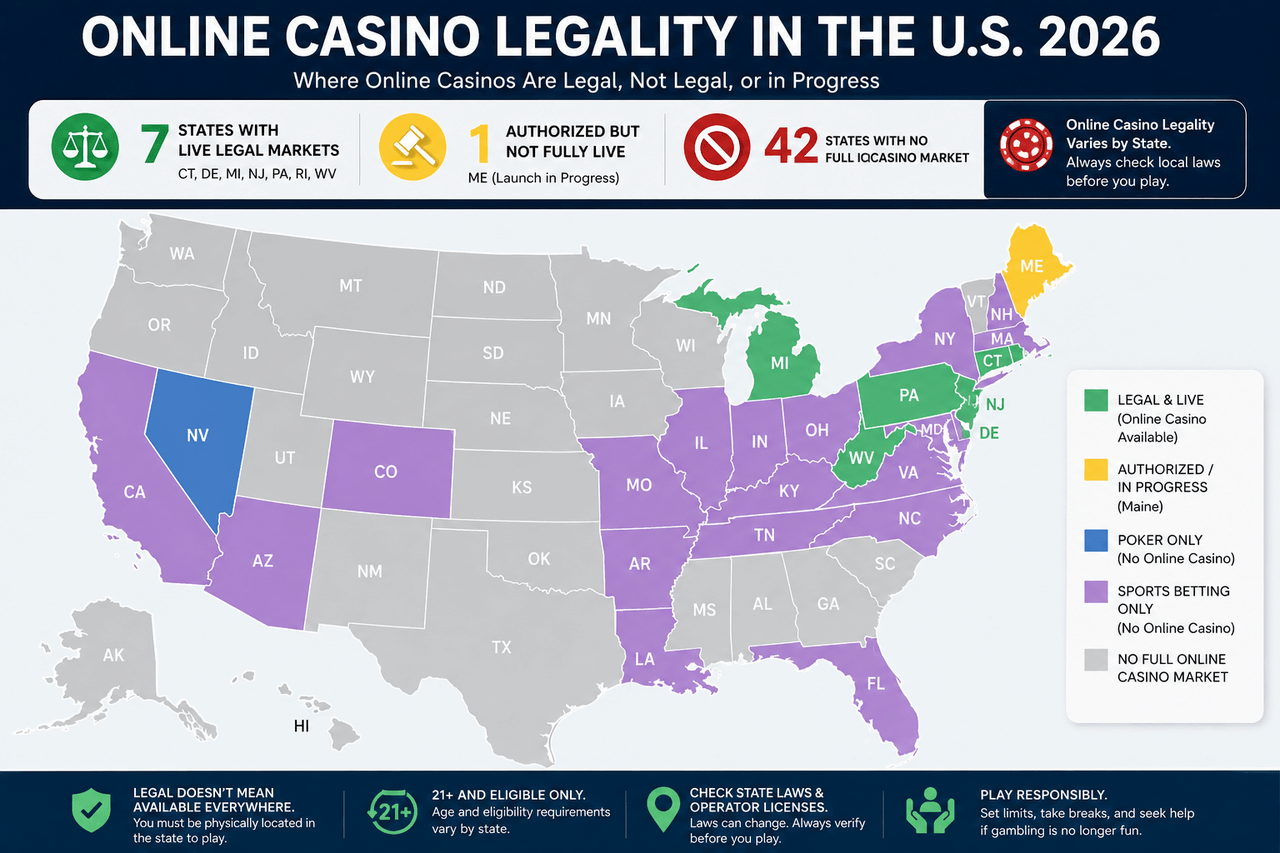
Online casino legality in the United States is decided state by state. As of 2026, 8 states have legalized or authorized real-money online casino gambling: Connecticut, Delaware, Maine, Michigan, New Jersey, Pennsylvania, Rhode Island, and West Virginia. Of those, 7 states have live regulated online casino markets, while Maine has authorized online casino gambling but is still in the implementation and launch-transition stage. The remaining 42 states do not currently have a full state-regulated online casino market.
For readers comparing state laws, online casino legality is best understood as a licensed-market question, not simply a question of whether a casino website is accessible. A legal online casino usually means a state-licensed platform offering real-money slots, blackjack, roulette, baccarat, video poker, or live dealer games to eligible adults physically located inside that state.
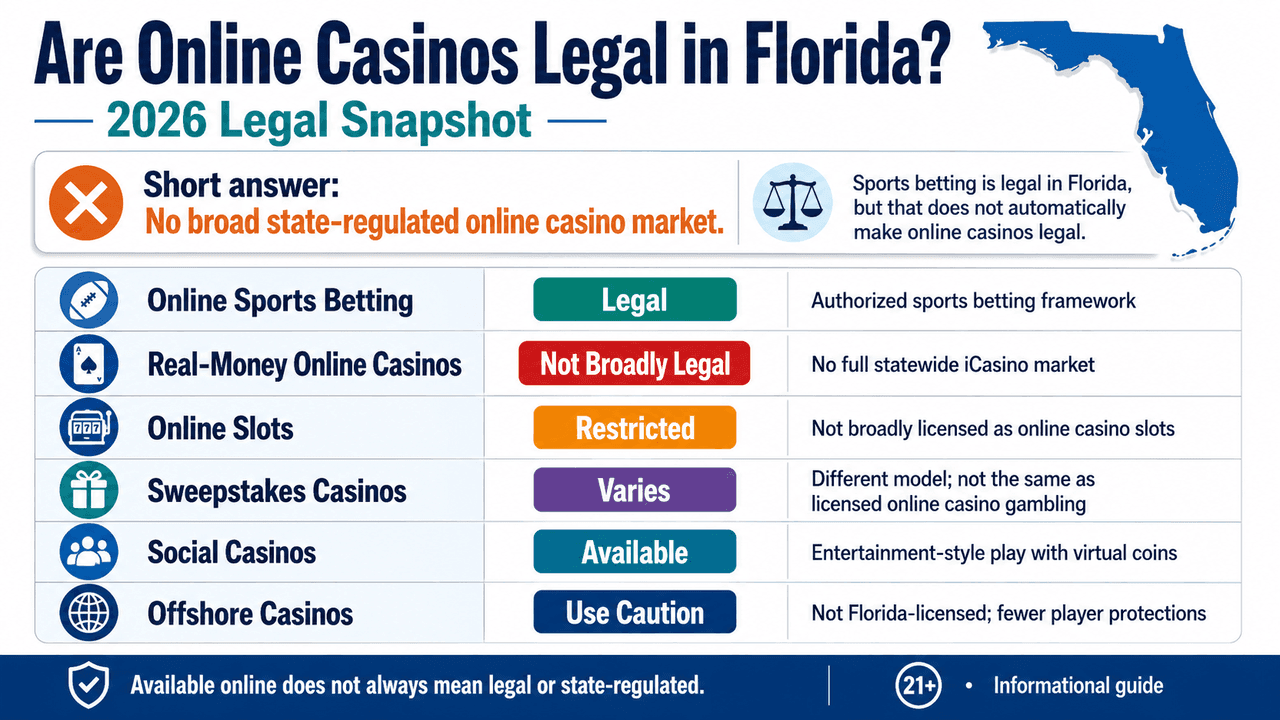
That does not mean every other form of online gambling is unavailable. Many states allow online sports betting, online poker, daily fantasy sports, lottery products, horse racing betting, social casinos, or sweepstakes-style platforms under separate rules. The key point is simple: sports betting legality does not automatically make online casino apps legal.
Online Casino Legality Snapshot
Category | Number of States | What It Means |
|---|---|---|
Legal / authorized real-money online casino states | 8 | State law allows or has authorized regulated iCasino |
Live regulated online casino markets | 7 | Players can access licensed online casino apps where eligible |
Authorized but not fully live | 1 | Maine has authorized online casino gambling, but rollout depends on implementation |
No full state-regulated online casino market | 42 | No broad legal iCasino framework for real-money casino apps |
Maine is the most important nuance in current U.S. online casino legality because it sits between legal authorization and full market launch. Maine LD 1164 became law without the governor's signature in January 2026 and authorizes the Wabanaki Nations to operate online gambling through a tribal-focused framework. The Maine Legislature lists LD 1164 as enacted on January 11, 2026, with the governor's action marked as unsigned.
That makes Maine different from states such as New Jersey, Michigan, and Pennsylvania, where legal online casino apps are already live and widely available to eligible in-state users.
Traffic-Light State Status Matrix
This quick matrix helps readers understand online casino legality without confusing online casinos with sports betting, poker, or sweepstakes products.
Status Label | Meaning | States / Examples |
|---|---|---|
🟢 Legal & Live iCasino | Full state-regulated online casino apps are available | CT, DE, MI, NJ, PA, RI, WV |
🟡 Authorized / Launch Transition | Legal framework exists, but full launch is still developing | ME |
🔵 Poker Only / Limited Online Casino Category | Online poker may be available, but not full online casino apps | NV |
🟠 Sports Betting Only | Online sportsbooks may be legal, but online casinos are not | FL, NY, IL, OH, MA, AZ, CO, TN, VA |
⚠️ Sweepstakes / Social Casino Access May Vary | Not the same as licensed iCasino | Many non-iCasino states |
🚨 Enforcement-Risk / Unlicensed Gambling Focus | State attention may target unlicensed platforms, payments, or sweepstakes models | MD and other active enforcement states |
⚫ No Full iCasino Market | No broad state-regulated online casino framework | Most U.S. states |
This traffic-light approach is important because online casino legality does not follow one national rule. A state can allow mobile sports betting, ban online casino apps, tolerate some social casino access, and still pursue enforcement against unlicensed gambling products.
States Where Online Casinos Are Legal in 2026
The clearest online casino legality category is the group of states that have approved real-money iCasino under state law.
State | Status | Practical Notes |
|---|---|---|
Connecticut | Legal and live | Limited but regulated online casino market |
Delaware | Legal and live | One of the earliest regulated iGaming states |
Michigan | Legal and live | Large legal online casino market |
New Jersey | Legal and live | Mature, highly developed online casino market |
Pennsylvania | Legal and live | Broad legal online casino and poker market |
Rhode Island | Legal and live | Legal online casino market launched more recently |
West Virginia | Legal and live | Regulated online casino apps available |
Maine | Authorized / launch transition | LD 1164 authorized tribal online gaming, but rollout is still developing |
In legal and live states, players usually must be physically located inside the state, meet the legal age requirement, complete identity checks, and use operators licensed or approved by that state.
For readers comparing legal markets, FreeBetSpin organizes state-by-state casino law updates and player safety guidance.
Full 50-State Online Casino Legality Table
This table focuses on real-money online casino apps, not sports betting. A state may allow online sports betting while still having no legal online casino market.
State | Online Casino Status | Common Legal Alternatives |
|---|---|---|
Alabama | No full iCasino market | DFS access may vary, retail gambling limited |
Alaska | No full iCasino market | Social casinos, sweepstakes access may vary |
Arizona | No full iCasino market | Legal online sports betting, tribal casinos |
Arkansas | No full iCasino market | Retail casinos, sports betting |
California | No full iCasino market | Tribal casinos, cardrooms, social casinos |
Colorado | No full iCasino market | Online sports betting, retail casinos |
Connecticut | Legal and live | State-regulated online casino and sports betting |
Delaware | Legal and live | State-regulated online casino |
Florida | No full iCasino market | Legal online sports betting, tribal casinos |
Georgia | No full iCasino market | Social casinos, sweepstakes access may vary |
Hawaii | No full iCasino market | Highly restricted gambling environment |
Idaho | No full iCasino market | Tribal casinos, lottery |
Illinois | No full iCasino market | Online sports betting, retail casinos |
Indiana | No full iCasino market | Online sports betting, retail casinos |
Iowa | No full iCasino market | Online sports betting, retail casinos |
Kansas | No full iCasino market | Online sports betting, retail casinos |
Kentucky | No full iCasino market | Online sports betting, horse racing |
Louisiana | No full iCasino market | Online sports betting, retail casinos |
Maine | Authorized / launch transition | Online sports betting, iCasino rollout developing |
Maryland | No full iCasino market | Online sports betting, retail casinos |
Massachusetts | No full iCasino market | Online sports betting, retail casinos |
Michigan | Legal and live | State-regulated online casino, poker, sports betting |
Minnesota | No full iCasino market | Tribal casinos |
Mississippi | No full iCasino market | Retail casinos, limited sports betting |
Missouri | No full iCasino market | Sports betting framework developing / retail options |
Montana | No full iCasino market | Lottery-linked sports betting, retail gambling |
Nebraska | No full iCasino market | Retail casino expansion, horse racing |
Nevada | Online poker only | Retail casinos, legal online poker |
New Hampshire | No full iCasino market | Online sports betting, lottery |
New Jersey | Legal and live | State-regulated online casino, poker, sports betting |
New Mexico | No full iCasino market | Tribal casinos |
New York | No full iCasino market | Online sports betting, retail casinos |
North Carolina | No full iCasino market | Online sports betting, tribal casinos |
North Dakota | No full iCasino market | Tribal casinos, charitable gaming |
Ohio | No full iCasino market | Online sports betting, retail casinos |
Oklahoma | No full iCasino market | Tribal casinos |
Oregon | No full iCasino market | Lottery-linked sports betting, tribal casinos |
Pennsylvania | Legal and live | State-regulated online casino, poker, sports betting |
Rhode Island | Legal and live | State-regulated online casino and sports betting |
South Carolina | No full iCasino market | Highly limited gambling options |
South Dakota | No full iCasino market | Retail casino gambling in Deadwood, tribal casinos |
Tennessee | No full iCasino market | Online sports betting |
Texas | No full iCasino market | Social casinos, sweepstakes access may vary |
Utah | No full iCasino market | Highly restricted gambling environment |
Vermont | No full iCasino market | Online sports betting |
Virginia | No full iCasino market | Online sports betting, retail casinos |
Washington | No full iCasino market | Tribal casinos, retail sports betting |
West Virginia | Legal and live | State-regulated online casino and sports betting |
Wisconsin | No full iCasino market | Tribal casinos |
Wyoming | No full iCasino market | Online sports betting |
The most useful way to read this online casino legality table is not "legal vs illegal everywhere." It is better to ask whether a state has a licensed and regulated real-money iCasino framework. In most states, the answer is still no.
Maine Update: Why "Authorized" Does Not Always Mean Live
Maine deserves its own section because it is the newest and most complicated entry in the legal online casino group.
LD 1164, titled An Act to Create Economic Opportunity for the Wabanaki Nations Through Internet Gaming, authorizes Maine's tribal governments to operate online gambling. Governor Janet Mills announced in January 2026 that she would allow the bill to become law without her signature.
The law is important for online casino legality because it moves Maine into the authorized category, but players should not treat Maine like New Jersey or Michigan yet. Rulemaking, licensing, operator partnerships, technical setup, responsible gambling standards, and launch details still matter.
Maine Status Card
Maine Issue | Current Meaning |
|---|---|
Legal framework | LD 1164 enacted in January 2026 |
Operator model | Tribal-focused framework involving Wabanaki Nations |
Market status | Authorized, but not a mature live iCasino market |
Player access | Launch timing and app availability depend on implementation |
Legal dispute | Oxford Casino / Churchill Downs litigation has challenged the tribal-exclusive structure |
The Oxford Casino lawsuit adds another layer of complexity. Reports state that Oxford Casino Hotel challenged LD 1164 in federal court, arguing against the tribal-exclusive online casino framework. That dispute does not erase the law, but it does show why Maine should be described as "authorized / launch transition" rather than simply "fully live."
For SEO and reader clarity, Maine should be counted among authorized legal online casino states, but not grouped casually with fully operational markets.
2026 Enforcement Shift: Payments, Processors, and Unlicensed Gambling
The biggest 2026 trend in U.S. online casino legality is not just whether a state has passed an iCasino law. It is how states are starting to target the broader infrastructure around unlicensed online gambling.
Maryland HB 1226 is a useful example. The bill, titled the Maryland Illegal Online Gambling Enforcement Act, aimed to prohibit people from knowingly operating, offering, conducting, engaging in, promoting, or supporting illegal online gambling in the state. The official Maryland legislative page lists subjects that include electronic funds transfer, consumer protection, internet, mobile devices, gaming and gambling, unfair trade practices, and payment-related concepts.
This matters because enforcement can move beyond the gambling operator itself. A state can also look at affiliates, advertising, technology support, payment routing, digital wallets, or service providers connected to unlicensed gambling activity.
2026 Enforcement Risk Card
Enforcement Layer | Why It Matters |
|---|---|
Operators | Sites may be targeted for offering unlicensed casino-style games |
Affiliates / promoters | Marketing illegal or unlicensed gambling can create risk |
Payment processors | Transaction routing may become part of enforcement |
Digital wallets | Wallet support can be reviewed in illegal gambling cases |
Banks / card networks | Payment blocking can affect deposits and withdrawals |
Sweepstakes platforms | Dual-currency models may face more scrutiny |
Consumers | Players may lose access, face account closures, or lack complaint options |
This payment-enforcement trend strengthens one of the core rules of online casino legality: a site being online, accepting deposits, or advertising casino-style games does not make it legal or state-regulated.
Why Sports Betting Does Not Mean Online Casinos Are Legal
The growth of legal sports betting has made online casino legality more confusing. After sports betting expanded across many states, some players assumed online slots and table games followed the same path. They did not.
Online sports betting and online casino gambling are separate legal categories. A sportsbook lets users wager on sports events. An online casino offers games such as slots, blackjack, roulette, baccarat, video poker, and live dealer tables.
Product | What It Covers | Legal Pattern in the U.S. |
|---|---|---|
Online sportsbook | Sports wagers, props, parlays, totals | Legal in many states |
Online casino | Slots, table games, live dealer | Legal in only a small group of states |
Online poker | Peer-to-peer poker | Legal in selected states |
Lottery | State lottery products | Separate state authority |
Sweepstakes casino | Promotional prize model | Not the same as licensed iCasino |
Social casino | Entertainment play with virtual coins | Not traditional real-money gambling |
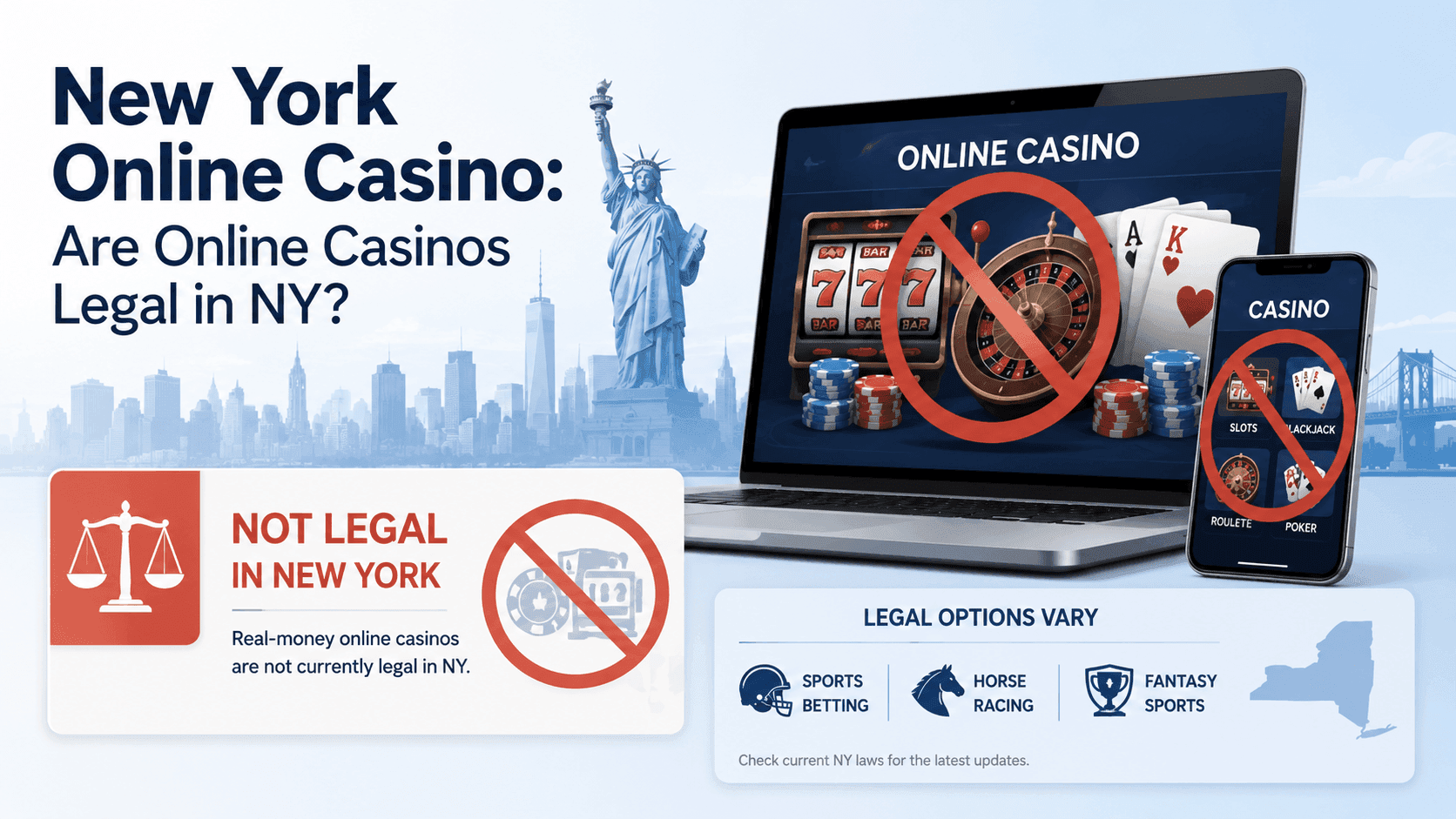
This online casino legality distinction matters in states such as Florida, New York, Illinois, Ohio, and Massachusetts. Each has legal sports betting, but none currently has a full state-regulated online casino market.
Online Casino vs Poker vs Sweepstakes vs Social Casino
Not every casino-style website counts as legal online casino gambling. That is why online casino legality depends on both the product model and the state.
Product Type | Real-Money Gambling? | State-Regulated iCasino? | Main Player Caution |
|---|---|---|---|
State-licensed online casino | Yes | Yes | Only available in legal states |
Online poker | Yes, where legal | Often separate | Poker law may differ from casino law |
Sweepstakes casino | Prize redemption model | No | Rules and state access can vary |
Social casino | Usually entertainment play | No | Virtual coins are not the same as real-money casino play |
Offshore casino | Yes | No U.S. state oversight | Higher payment and consumer protection risk |
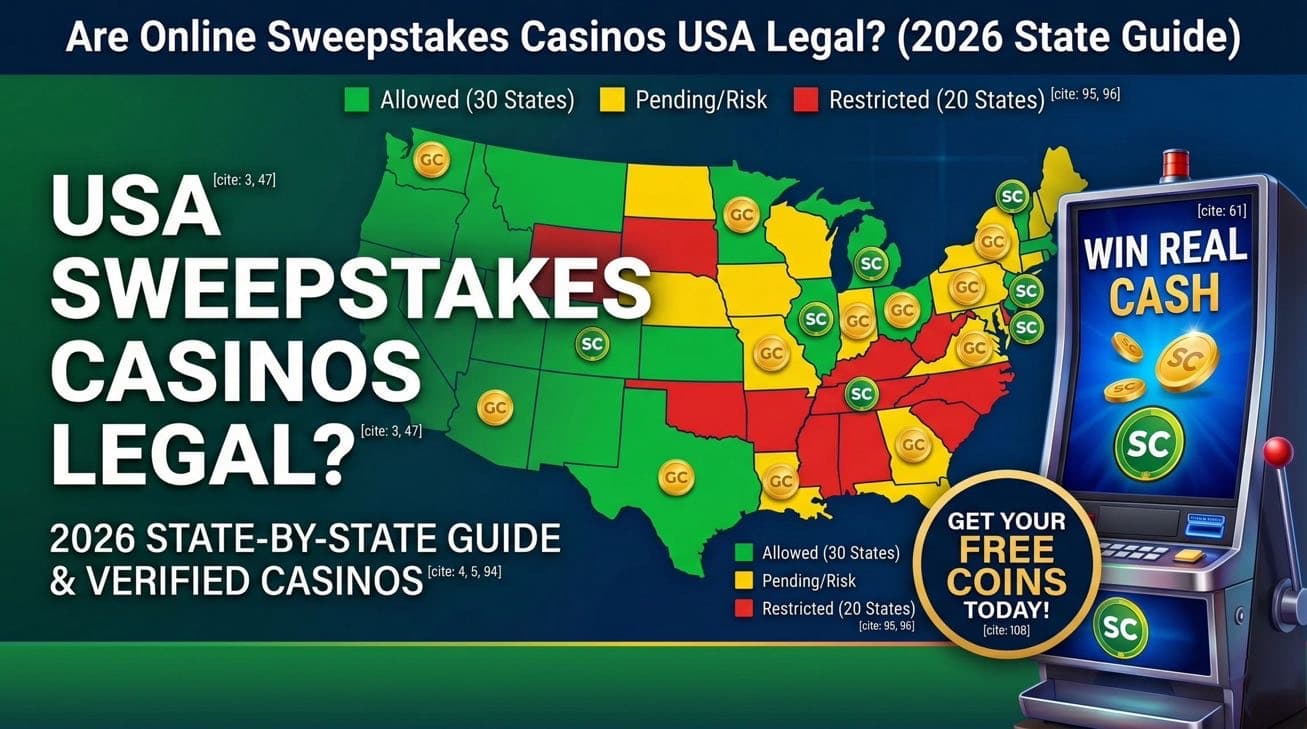
A sweepstakes casino may offer slots-style games and prize redemption, but it is not the same as a state-licensed online casino. A social casino may look like a casino app, but it usually uses virtual coins for entertainment. An offshore casino may accept U.S. players, but that does not mean it is legal or state-regulated in the player's state.
For a deeper comparison of social and sweepstakes models, FreeBetSpin explains how these products differ from licensed online casino gambling.
What Can Players Use in States Without Legal Online Casinos?
In states without legal real-money online casinos, the safest path is to look for products that are clearly allowed under that state's current rules. The answer depends on the state.
In non-iCasino states, online casino legality is usually less about finding a workaround and more about understanding which gambling products are actually authorized.
Common alternatives may include legal online sports betting, retail casino gambling, tribal casinos, online poker where permitted, state lottery products, horse racing betting, social casino games for entertainment, and sweepstakes-style platforms where allowed by platform terms and state rules.
These alternatives should not be treated as identical. A sportsbook is not an online casino. A lottery app is not an online casino. A sweepstakes platform is not a state-licensed iCasino.
Non-iCasino State Alternatives
Player Goal | Safer Legal Direction |
|---|---|
Bet on sports | Use state-licensed sportsbooks where legal |
Play casino-style games casually | Consider social casino entertainment |
Use prize-style promotional games | Review sweepstakes terms and state rules |
Play poker online | Check whether online poker is legal in that state |
Visit real casino games | Use licensed retail or tribal casinos where available |
Avoid unlicensed risk | Do not treat offshore casinos as legal substitutes |
If the goal is casino-style entertainment without using an unregulated offshore site, social casinos and sweepstakes platforms may be more relevant in non-iCasino states. Players should still review account rules, eligibility, redemption terms, and state restrictions before signing up.
Offshore Casino Risks and Online Casino Legality
Offshore casinos often appear in searches for states where online casinos are not legal. They may accept players from the U.S., but accessibility does not equal legality.
Offshore access is one of the most common areas where online casino legality is misunderstood. If an online casino is not licensed by the relevant U.S. state regulator, players may not have the same protections they would receive in a regulated market.
Offshore Risk | Why It Matters |
|---|---|
No state license | The site is not approved by the player's state |
Limited complaint options | No clear state regulator to contact |
Withdrawal disputes | Payment delays or denials can be harder to resolve |
Account closure risk | Offshore terms may be difficult to challenge |
Unclear game oversight | Fairness standards may not match U.S. regulated markets |
Weaker safer gambling tools | Limits and self-exclusion may be less effective |
Payment uncertainty | Deposit and withdrawal methods may change quickly |
Financial blocking risk | Banks, processors, or wallets may restrict transactions |
A website accepting U.S. traffic should never be described as a legal online casino unless it is licensed or authorized by the relevant state.
How to Check Whether an Online Casino Is Legal in Your State
A quick legality check can prevent a lot of confusion. Do not start with the bonus. Start with the license.
A proper online casino legality check should include the state regulator, the operator license, the product type, the player's physical location, and the payment method being used.
What to Check | Why It Matters |
|---|---|
State regulator listing | Confirms whether the operator is approved |
Operator license | Shows who is authorized to offer games |
Geolocation rules | Legal apps restrict play to approved states |
KYC and age checks | Helps enforce legal age and identity rules |
Responsible gambling tools | Shows player protection standards |
Complaint process | Gives players a dispute route |
Payment terms | Reduces withdrawal confusion |
Processor transparency | Helps identify whether payments are handled through regulated channels |
Legal online casino apps usually require users to be physically located in the approved state, pass identity checks, meet the legal age requirement, and follow state-specific rules. If a site does not explain these basics clearly, treat that as a warning sign.
FreeBetSpin also recommends checking safer gambling tools before using any real-money gambling product.
What Could Change Next?
The U.S. online casino market is growing slowly compared with online sports betting. Lawmakers in several large states have discussed iGaming bills, but legalization is never guaranteed.
The states most often watched for future iCasino debate include New York, Illinois, Maryland, Massachusetts, Indiana, and New Hampshire. The arguments usually focus on tax revenue, land-based casino impact, labor concerns, tribal gaming rights, responsible gambling policy, and whether online casino apps might reduce or support existing casino revenue.
The 2026 picture also includes a sharper enforcement layer. Maryland HB 1226 shows that some state discussions are moving beyond simple definitions of gambling and toward infrastructure: promotion, payment routing, technology support, and indirect support for illegal online gambling. That is a major shift for online casino legality because it affects not just casino operators, but the ecosystem around them.
Maine is the clearest recent example of market movement. It is authorized through LD 1164, but the launch path involves tribal exclusivity, rulemaking, operator partnerships, and litigation pressure.
Until new laws are passed and implemented, players should use the current online casino legality status by state rather than assuming their state will legalize soon.
Responsible Gambling and Legal Safety
Gambling is for adults only. Legal age rules vary by state and product, and players should only use gambling products that are legal and available where they are physically located.
Do not use a VPN, false identity, false address, or false location to bypass geolocation, age checks, KYC, or state restrictions. Those systems exist because gambling laws are state-specific.
Set a budget before playing. Use deposit limits and time limits when available. Do not gamble with money needed for rent, food, bills, debt, or family responsibilities. If gambling causes stress, secrecy, financial pressure, or loss of control, stop and seek help.
The National Council on Problem Gambling provides support resources, and 1-800-GAMBLER is widely used as a problem gambling helpline in the U.S.
Final Takeaway on Online Casino Legality
Online casino legality in the U.S. remains limited, state-specific, and increasingly tied to enforcement infrastructure. In 2026, only 8 states have legalized or authorized real-money online casinos, and only 7 have live regulated online casino markets. Maine is authorized through LD 1164 but still moving through implementation and launch development. The other 42 states do not currently have a full state-regulated online casino market.
The safest way to understand the market is to separate product types. Online sports betting, online poker, social casinos, sweepstakes casinos, offshore casinos, and state-licensed online casinos are not the same thing.
If an online casino is not licensed or authorized by the relevant state, players should not treat it as a legal regulated option.